The Amber Room: A Six-Ton Looted Treasure That Never Reappeared.
A chamber of amber panels, gold leaf, and inset gemstones built for Frederick I of Prussia in the first years of the 18th century, given to Peter the Great in 1716, and installed at the Catherine Palace outside Saint Petersburg, where it stood for 225 years. Disassembled by the German Army in 1941 and trucked to Königsberg Castle. Last documented there in early 1944. Never seen since. The reconstruction at Tsarskoye Selo is now complete; the original has not been found.
AnomalyDesk is reader-supported. Articles may contain affiliate links to books and primary-document collections. Read our full funding disclosure.
.jpg)
Confidence key — claims in this file are tagged as follows Verified primary documentary support · Claimed asserted by a named party, not independently confirmed · Disputed credible sources contradict each other · Unverified we could not substantiate it · how we decide
What the Amber Room was, in a paragraph.
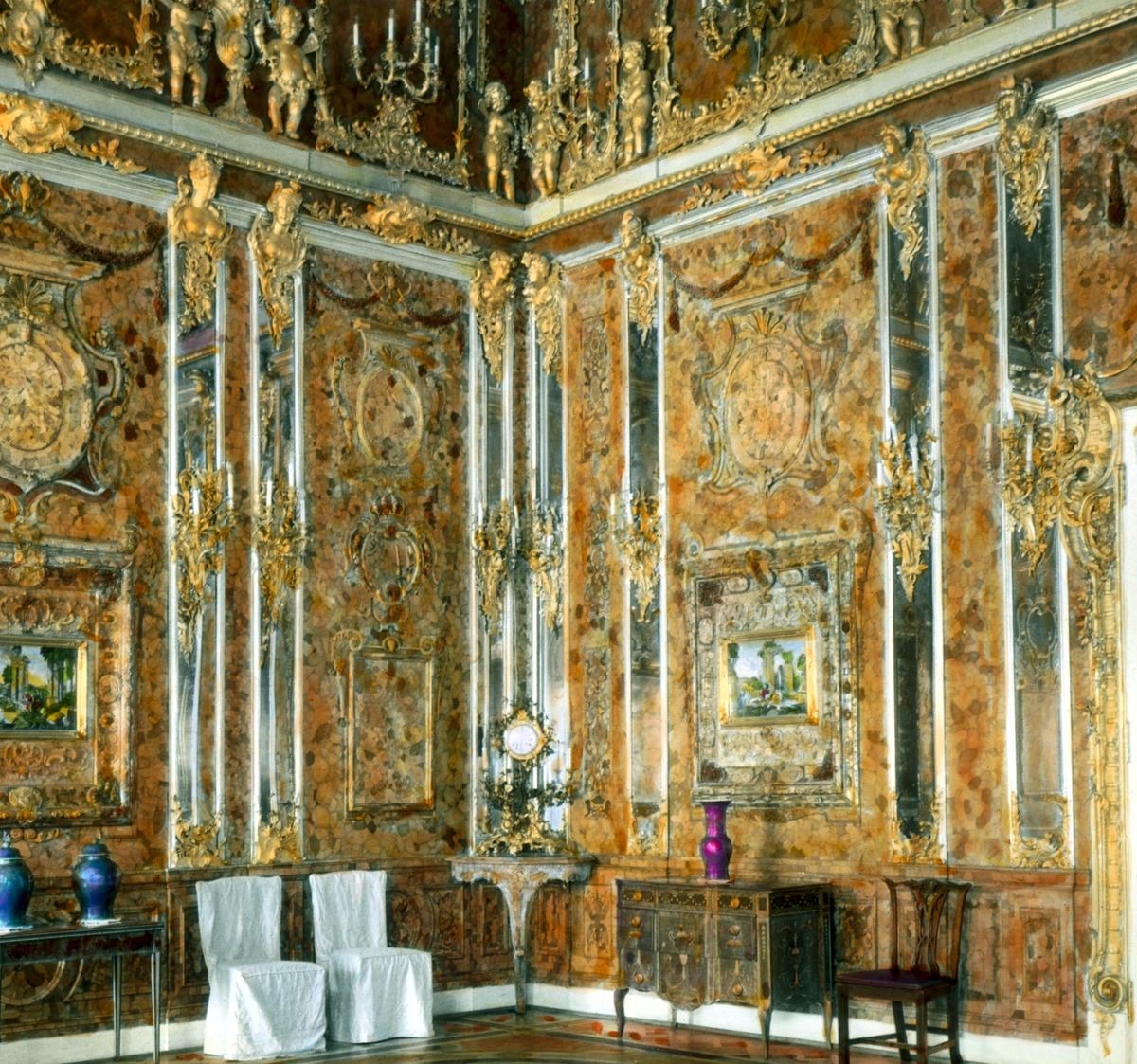
The Amber Room was a chamber-interior decoration consisting of approximately 6 tons of amber paneling, gold-leaf framing, inlaid Florentine-mosaic panels, and decorative gems. It was originally designed by the German sculptor Andreas Schlüter and the Danish amber craftsman Gottfried Wolfram and constructed between 1701 and 1707 in the Berlin City Palace under Frederick I, King in Prussia. In 1716, Frederick I's successor Frederick William I gave the room as a diplomatic gift to Tsar Peter the Great of Russia in connection with the Russo-Prussian alliance against Sweden in the Great Northern War. The panels were transported to Saint Petersburg in eighteen large crates and were initially installed in the Winter Palace. In 1755, on the orders of Empress Elizabeth, the room was relocated to the Catherine Palace at Tsarskoye Selo (the imperial summer residence outside the city) and was substantially enlarged and reworked by the Italian architect Bartolomeo Rastrelli, the Italian goldsmith Alexander Martelli, and several other amber craftsmen brought to Russia specifically for the project. The expanded room stood at the Catherine Palace from 1755 until 1941, becoming over those 186 years a major item of European cultural patrimony. Following the German invasion of the Soviet Union in June 1941, German Army Group North reached Tsarskoye Selo in September 1941; the Amber Room had not been successfully evacuated by Soviet curators (its amber panels were too fragile for the rapid evacuation conducted on other parts of the imperial collections), and the German occupation forces under SS supervision disassembled the room in October 1941 and transported it in 27 crates to Königsberg Castle in East Prussia. The room was reassembled and displayed at Königsberg through 1943 under the direction of Alfred Rohde, the castle's curator. As the Eastern Front advanced toward East Prussia in late 1943 and early 1944, the room was again disassembled and crated; its movements from this point are the central question. The Allied bombing of Königsberg in August 1944 (RAF Bomber Command's 250 and 270 Lancaster-bomber raids on August 26–27 and 29–30) severely damaged the castle. The Soviet capture of Königsberg in April 1945 was followed by further damage and by the demolition of the castle's surviving structures by Soviet authorities in 1968. The Amber Room has not been recovered. A long series of search campaigns, principally in eastern Germany, Poland, and the Kaliningrad oblast, has continued from the 1950s to the present without producing the original room. A reconstruction was begun in 1979 at the Catherine Palace by Russian amber craftsmen, was substantially completed in 2003, and was formally opened on May 31, 2003 at the tercentenary of Saint Petersburg, with full completion in 2004.
The documented record.
The original construction (1701–1707)
The Amber Room was designed by Andreas Schlüter and the Danish craftsman Gottfried Wolfram for Frederick I of Prussia, with construction beginning in 1701 and completion of the principal panel work in 1707. Verified The amber was sourced principally from the East Prussian Baltic coast deposits (the Königsberg-area amber industry was the principal European supplier through this period); the gold-leaf framing was added in the Berlin workshops. The room was installed in the Berlin City Palace and was apparently never popular with Frederick William I, who succeeded his father in 1713 and used the room infrequently before deciding to give it to Peter the Great [1].
The 1716 diplomatic gift
The transfer to Russia occurred in the context of the Russo-Prussian alliance against Sweden during the Great Northern War. Verified Frederick William I sent the room's panels to Peter the Great as a diplomatic gift in 1716; the consignment was transported in 18 large crates and was accompanied by detailed installation drawings. Peter installed the panels in the Winter Palace in Saint Petersburg, where they remained through the 1740s [2].
The 1755 relocation and expansion
Empress Elizabeth ordered the relocation of the Amber Room to the Catherine Palace at Tsarskoye Selo in 1755, in connection with the broader Rastrelli renovation of the palace into the principal Russian imperial summer residence. Verified Bartolomeo Rastrelli, Alexander Martelli, and a team of imported amber craftsmen substantially enlarged the room from its original Berlin dimensions (suitable for the Berlin City Palace) to the much larger space at the Catherine Palace, with the addition of substantial new amber paneling, mirror-framed lighting elements, and four Florentine-mosaic panels representing the four senses (sight, hearing, taste, and touch) sent by the Empress of Austria, Maria Theresa, as a gift to Elizabeth in 1759. The expanded room measured approximately 16 meters square and 7.8 meters high, with the amber paneling covering some 55 square meters of wall surface [2][3].
The 1941 capture
Operation Barbarossa began on June 22, 1941. Verified German Army Group North under Field Marshal Wilhelm Ritter von Leeb advanced through the Baltic states and reached the outskirts of Leningrad (Saint Petersburg) in early September 1941. The Catherine Palace, in the immediate path of the advance, was captured on September 17, 1941. The Soviet curatorial staff, under the direction of Anatoly Kuchumov, had attempted partial evacuation of the palace's contents in the weeks before capture; most movable items were evacuated successfully, but the Amber Room presented particular difficulties because the amber panels were too brittle to be quickly disassembled without specialist equipment. Kuchumov ordered the panels to be wallpapered over in an attempt to disguise them; the disguise was discovered by the German forces almost immediately. In October 1941, on orders from Berlin, the panels were disassembled by a German team and packed in 27 crates for transport to Königsberg [4].
Königsberg, 1941–1944
The Amber Room arrived at Königsberg Castle in late October 1941. Verified Alfred Rohde, the castle's curator, supervised its reassembly in the castle's third-floor ceremonial hall, where it was displayed (with public access on certain occasions) from 1942 through 1943. The reassembly was incomplete in some details: photographs from the Königsberg display period (held at the Bildarchiv Preussischer Kulturbesitz) show the principal panels in place but some smaller decorative elements absent. The mosaic panels appear to have been included in the Königsberg installation [5].
The 1944 disassembly
As the Soviet advance into East Prussia approached, Rohde was ordered to disassemble the room again for evacuation. Verified The disassembly took place in early 1944 (most sources date it to January–February 1944, though some date specific phases earlier). The crated panels were stored in the castle's lower levels through the spring and summer of 1944. The Allied bombing of Königsberg on August 26–27 and 29–30, 1944 caused extensive damage to the castle's upper levels but did not penetrate to the basement storage areas; on Rohde's testimony to Soviet investigators in 1945, the crates survived the bombing [4][6]. Whether the crates remained at the castle through the Soviet capture in April 1945, or whether they had been moved earlier, is the central unresolved question.
The 1945 Soviet capture and the Rohde investigation
Königsberg fell to the Red Army on April 9, 1945. Verified A Soviet commission under Alexander Brusov was assigned to locate the Amber Room. Brusov interrogated Alfred Rohde in May–June 1945; Rohde initially stated that the crates had remained at the castle and had presumably been destroyed in the August 1944 bombing, but later (in subsequent interviews and in a partial diary recovered after his death) suggested that some or all of the crates had been moved before the Soviet capture [6]. Rohde and his wife died on December 7, 1945 from dysentery (or, on some contested accounts, from poisoning) before he could complete his testimony. The Brusov commission's final report (1946) concluded that the room had probably been destroyed in the castle bombing, although this conclusion was not held to with full confidence and was reopened multiple times in subsequent decades [7].
The Erich Koch claim and counterclaim
Erich Koch, the Gauleiter of East Prussia, was captured by the British in 1949 and extradited to Poland, where he was tried and convicted of war crimes in 1959 and held in Polish custody until his death in 1986. Claimed Across the 1960s and 1970s, Koch made multiple statements, some contradictory, claiming personal knowledge of the Amber Room's removal from Königsberg before the Soviet capture; specific destinations he proposed varied between an underground bunker in the Königsberg area, a location in Saxony, and other sites in eastern Germany and Poland. Koch's statements were investigated by both Polish and Soviet authorities; none of his proposed destinations yielded the room, and his testimony is generally considered unreliable by post-war investigators [8].
The 1968 castle demolition
The damaged Königsberg Castle ruins were demolished by Soviet authorities in 1968 under orders from Leonid Brezhnev. Verified The site was subsequently developed as the location for the never-completed House of Soviets. The 1968 demolition removed any possibility of additional in-situ archaeological investigation at the castle, although excavations of the cleared site continued sporadically through the 1970s and 1980s [9].
The 1997 Bremen recovery
In 1997, German police in Bremen recovered a single Florentine-mosaic panel that was identified as one of the four "sense" mosaics originally sent by Maria Theresa to Elizabeth in 1759. Verified The panel had been in the possession of the family of a German officer who had taken it from Königsberg in 1944 or 1945 as personal loot, separate from the main Amber Room consignment. The recovery confirmed that at least some elements of the room had been removed from Königsberg before the Soviet capture, and was returned to the Catherine Palace in 2000 for inclusion in the reconstruction [10].
The 2003–2004 reconstruction
Reconstruction of the Amber Room at the Catherine Palace began in 1979 under Soviet amber-master Alexander Krylov and the Tsarskoye Selo Amber Workshop. Verified The project was substantially completed for the May 31, 2003 tercentenary of Saint Petersburg, with the formal opening by President Vladimir Putin and German Chancellor Gerhard Schröder. Full completion (including some final decorative elements) was achieved in 2004. The reconstruction used approximately 6 tons of new Baltic amber and incorporated the recovered 1997 Bremen mosaic alongside the period photographs, architectural drawings, and surviving original component fragments retained in Russian collections [11].
The continuing search campaigns
Search campaigns have continued throughout the post-war period: Verified
- 2017: Polish investigators conducted a sonar survey of the Mámry Lake reservoir in northeastern Poland, on the theory that the room might have been deliberately sunk during the 1944 transport phase.
- 2020: German investigators excavated portions of an underground bunker complex near Wuppertal that had been proposed as a possible destination for the room. No relevant material was recovered.
- September 2023: Polish investigators excavated a portion of the Mamerki bunker complex in Masuria (a major German military bunker site) following ground-penetrating radar indications. The recovery did not include Amber Room material.
- 2024: The Russian Ministry of Culture, in a status report, reaffirmed the Russian government's position that the search for the room remains an ongoing priority but acknowledged that no credible recovery prospect was active.
The candidate fates.
Hypothesis: Destruction in the August 1944 bombing
The earliest formal conclusion (the 1946 Brusov commission report) and the position long held by Soviet investigators: the crates remained in Königsberg Castle and were destroyed in the August 1944 RAF bombing or in the subsequent Soviet capture and 1968 demolition. Claimed The principal physical evidence for this position is the absence of any subsequent documented sighting of the room and the documented severe damage to the castle. The principal evidence against this position is Rohde's own later testimony suggesting some or all of the crates had been moved earlier, and the 1997 Bremen recovery of one mosaic panel, which establishes that at least some elements survived the bombing.
Hypothesis: Removal to a hidden location, never relocated
The room (or its principal panels) was removed from Königsberg before the Soviet capture and was concealed at an unidentified location, presumably in eastern Germany, Poland, or the Soviet-occupied portions of central Europe, where it has remained undisturbed. Claimed The principal evidence for this position is the 1997 Bremen mosaic recovery (establishing the removal of at least some elements), Koch's claims, and various uncorroborated post-war reports. The principal evidence against is that no major recovery has occurred despite 80 years of search and that the principal proposed concealment sites (the various bunker investigations) have been substantially excavated without yielding the room.
Hypothesis: Removal and dispersal
The room was disassembled into its component panels and dispersed by individual German officers and civilians as the front collapsed; individual pieces may survive in private hands across the former Reich's territory and beyond, but the room as a whole no longer exists. Claimed The 1997 Bremen recovery is consistent with this framing. The hypothesis predicts that further individual elements may surface over time but that no consolidated recovery is possible.
Hypothesis: Soviet capture and concealment
A minority position holds that the Soviet capture of Königsberg recovered the room (or substantial parts of it), but that the recovery was not publicized, with the room being moved to a Soviet-held facility and concealed. Claimed The evidence for this position is essentially indirect (the perceived implausibility of complete destruction, the Soviet motivation to retain rather than disclose such a find). The hypothesis has been seriously argued but has not been substantiated. Unverified
The unanswered questions.
The 1944 evacuation route
If the room was removed from Königsberg before the Soviet capture, the specific transport route and destination remain unidentified. The most-discussed candidate destinations include various underground bunker sites in the former East Prussia, in Saxony, and in lower Silesia (now southwestern Poland); none has been confirmed by recovery.
The state of the panels at last documentation
The Königsberg display photographs from 1942–1943 are the last reliable images of the room. Disputed Whether the room was complete at Königsberg (some commentators have noted apparent gaps in the photographs), whether all panels were present, and whether the amber's structural condition had degraded during the 1941 disassembly and transport, are not fully resolved.
The Rohde testimony
Alfred Rohde's testimony to Soviet investigators in 1945 was given under conditions that may have compromised its reliability (Rohde was reportedly ill and died of dysentery within months). His later partial diary, recovered after his death, is internally inconsistent. The reliability of his various statements about the 1944 fate of the crates is contested in the secondary literature.
The Erich Koch claim
Koch made multiple statements about the room's removal across his Polish imprisonment from 1949 to 1986. The statements are mutually inconsistent and have not led to recovery. Whether any of Koch's information was genuine (and his statements deliberately fragmentary as a negotiation strategy) or whether he had no reliable information at all (and his statements were essentially fabricated for personal-survival reasons) is debated.
The Soviet investigation files
The full Soviet investigation files on the Amber Room from 1945–1991 are not all publicly accessible; Russian Federation researchers have had partial access since the 1990s, with continuing restrictions on portions related to Soviet wartime cultural-property handling. Whether these files contain additional information not yet in the public domain is unknown. Unverified
Primary material.
The accessible record on the Amber Room is held principally at:
- The State Museum-Preserve "Tsarskoye Selo" at the Catherine Palace, which holds the reconstruction's documentation, the surviving original component fragments retained in Russian collections, and the Russian-language search-campaign records.
- The Bildarchiv Preussischer Kulturbesitz, Berlin, which holds the Königsberg display-period photographs (1942–1943) and the original German architectural and inventory records on the room.
- The Russian Federation State Archive (GARF) and the Russian State Military Archive (RGVA), which hold the 1945–1946 Brusov commission files and subsequent Soviet investigation records.
- The German Bundesarchiv-Militärarchiv, which holds Wehrmacht and SS records relating to the Tsarskoye Selo capture and the Königsberg consignment.
- The Institute of National Remembrance (IPN), Poland, which holds the Erich Koch trial records and subsequent Polish-investigative material.
Critical individual documents include: the original 1716 transport inventory; the 1755 Rastrelli expansion drawings; the 1941 German disassembly records; the 1942–1943 Königsberg display photographs; the 1945–1946 Brusov commission report; the 1997 Bremen mosaic recovery records; the 2003–2004 reconstruction project documentation.
The sequence.
- 1701–1707 Original construction of the Amber Room in the Berlin City Palace under Schlüter and Wolfram.
- 1716 Frederick William I gives the room as a diplomatic gift to Peter the Great; transported to Saint Petersburg in 18 crates.
- 1755 Empress Elizabeth orders relocation to the Catherine Palace at Tsarskoye Selo; substantial expansion under Rastrelli, Martelli, and others.
- 1759 Maria Theresa of Austria sends the four Florentine "sense" mosaic panels as a gift to Elizabeth.
- June 22, 1941 German invasion of the Soviet Union (Operation Barbarossa) begins.
- September 17, 1941 German forces capture Tsarskoye Selo. The Amber Room had not been successfully evacuated.
- October 1941 German team disassembles the room and ships it in 27 crates to Königsberg Castle.
- 1942–1943 Room reassembled and displayed at Königsberg under Alfred Rohde.
- January–February 1944 Room disassembled again at Königsberg for evacuation; crates stored in castle's lower levels.
- August 26–30, 1944 RAF Bomber Command raids on Königsberg; severe damage to the castle's upper levels.
- April 9, 1945 Soviet capture of Königsberg.
- May–June 1945 Alexander Brusov leads Soviet investigation; interrogates Alfred Rohde.
- December 7, 1945 Alfred Rohde and his wife die in Königsberg (cause variously reported as dysentery or poisoning).
- 1946 Brusov commission final report concludes probable destruction in the August 1944 bombing.
- 1949 Erich Koch captured by British and subsequently extradited to Poland.
- 1959 Koch's Polish trial concludes; sentenced to imprisonment.
- 1968 Soviet authorities demolish the surviving ruins of Königsberg Castle.
- 1979 Reconstruction project at the Catherine Palace begins under the Tsarskoye Selo Amber Workshop.
- 1986 Death of Erich Koch in Polish custody.
- 1997 German police in Bremen recover one of the four Florentine "sense" mosaic panels from the family of a German officer; returned to Russia in 2000.
- May 31, 2003 Reconstructed Amber Room formally opened at the Catherine Palace by Putin and Schröder at the Saint Petersburg tercentenary.
- 2004 Final reconstruction details completed.
- 2017 Polish sonar survey of Mámry Lake reservoir.
- 2020 German investigation of an underground bunker complex near Wuppertal.
- September 2023 Polish investigation of the Mamerki bunker complex in Masuria.
- 2024 Russian Ministry of Culture status report reaffirms the search as an ongoing priority while acknowledging no active recovery prospect.
- 2026 The original Amber Room remains unrecovered; the reconstruction stands at the Catherine Palace.
Full bibliography.
- Blumberg, Jess. "A Brief History of the Amber Room." Smithsonian Magazine, July 31, 2007. Concise overview of the room’s history, wartime looting, and disappearance.
- Kuchumov, Anatoly. Personal papers on the 1941 Tsarskoye Selo evacuation, held at the State Museum-Preserve "Tsarskoye Selo."
- Rohde, Alfred. Das Bernsteinzimmer Friedrichs I. im Schloß zu Königsberg. Königsberg: Gräfe und Unzer, 1942. The Königsberg curator's monograph on the room as displayed.
- Scott-Clark, Catherine, and Levy, Adrian. The Amber Room: The Fate of the World's Greatest Lost Treasure. Walker & Company, 2004. The most comprehensive English-language investigative treatment.
- Bildarchiv Preussischer Kulturbesitz, Berlin. Photographs of the Amber Room as displayed at Königsberg Castle, 1942–1943.
- Brusov, Alexander. Final report of the Soviet commission of investigation on the Amber Room, 1946. State Archive of the Russian Federation (GARF).
- Russian State Military Archive (RGVA). Files on the 1945 Soviet investigation at Königsberg, partially declassified 1991 onward.
- Institute of National Remembrance (IPN), Poland. Erich Koch trial records (1959) and subsequent Polish-investigative material.
- State Museum-Preserve "Tsarskoye Selo." Reconstruction project documentation, 1979–2004.
- Federal Criminal Police Office (BKA), Germany. Records on the 1997 Bremen recovery of the Florentine "sense" mosaic panel.
- Putin, Vladimir, and Schröder, Gerhard. Joint statements at the May 31, 2003 reopening of the reconstructed Amber Room at the Catherine Palace.
- Plekhov, Yuri, and others. The Amber Room: Reborn from the Past. Saint Petersburg: Tsarskoye Selo State Museum-Preserve, 2003.
- Polish Ministry of Culture and National Heritage. Records on the September 2023 Mamerki bunker investigation.
- Ministry of Culture of the Russian Federation. 2024 status report on the Amber Room search.
Frequently asked questions.
What is The Amber Room?
The ~6-ton amber chamber built 1701-1707 for Frederick I of Prussia, given to Peter the Great in 1716, looted by Nazis from Tsarskoye Selo 1941 and last documented at Königsberg Castle 1944.
What is the current status of this case?
Lost. The original room has never been recovered. A reconstruction was completed at the Catherine Palace in 2004.
Where is the Amber Room now?
The original Amber Room has never been recovered. A full reconstruction, completed in 2004, is on display at the Catherine Palace in Tsarskoye Selo (the town of Pushkin), near St. Petersburg.
Where was the original Amber Room, and what happened to it?
It was installed at the Catherine Palace in Tsarskoye Selo. German forces looted it in 1941 and moved it to Königsberg (now Kaliningrad), where it was last documented in 1944 and then disappeared. It has never been found.
Has the Amber Room ever been found?
No. Despite more than 80 years of searching — sonar surveys, bunker excavations in Germany and Poland, and repeated official investigations — the original Amber Room has never been recovered. The only confirmed surviving fragment is one of the four Florentine "sense" mosaic panels, found in Bremen in 1997. What visitors see today at the Catherine Palace is a full reconstruction completed in 2004.
How much was the Amber Room worth?
Its value is frequently estimated at around $142 million in 2007 dollars, though as a unique and irreplaceable cultural artifact its true worth is effectively unquantifiable. It contained roughly 6 tons of amber together with gold-leaf framing and inset gemstones, which is why it was nicknamed the "Eighth Wonder of the World."