The Edgewood Arsenal Experiments: Three Decades of Chemical-Agent Testing on Soldier-Volunteers.
Between 1948 and 1975, the U.S. Army's Medical Research Laboratory at Edgewood Arsenal in Maryland exposed approximately 7,000 enlisted soldier-volunteers to chemical warfare agents and incapacitating drugs — LSD-25, the glycolate BZ, the nerve agent VX, sarin precursors, mescaline, PCP, and roughly 250 other compounds — in pursuit of both offensive and defensive military objectives. The volunteers signed consent forms whose adequacy the Army does not defend today.
AnomalyDesk is reader-supported. Articles may contain affiliate links to books and primary-document collections. Read our full funding disclosure.
Confidence key — claims in this file are tagged as follows Verified primary documentary support · Claimed asserted by a named party, not independently confirmed · Disputed credible sources contradict each other · Unverified we could not substantiate it · how we decide
What happened at Edgewood, in a paragraph.
The Edgewood Arsenal experiments were a U.S. Army Chemical Corps human-subject research program, conducted at the Medical Research Laboratory at Edgewood Arsenal in Maryland from 1948 through 1975, in which approximately 7,000 enlisted soldier-volunteers were exposed to a wide range of chemical warfare agents and incapacitating drugs. The program's stated objectives were defensive (understanding the physiological and psychological effects of agents that might be used against U.S. forces, and the efficacy of countermeasures and antidotes) and offensive (developing chemical and behavioral incapacitants that could be used against enemy forces). The substances tested included the lysergic acid derivative LSD-25; the glycolate anticholinergic BZ (3-quinuclidinyl benzilate), a potent incapacitating agent developed in the late 1950s and the principal focus of the Army's 1960s-era nonlethal-incapacitant work; the organophosphate nerve agent VX; sarin and sarin precursors; mescaline; PCP (phencyclidine); CS and CR riot-control agents; and an additional roughly 250 to 270 compounds whose Army documentation has been recovered in the post-2003 disclosure process. The medical direction of the program through its central 1960s period was provided by Dr. James S. Ketchum, a psychiatrist whose subsequent memoir Chemical Warfare: Secrets Almost Forgotten (2006) is the most candid first-person account of the program from inside. The program was institutionally and substantively connected to the CIA's contemporaneous MKULTRA and MKOFTEN behavioral-control research; Edgewood's facilities and subject pool were used for CIA-sponsored testing, and several MKULTRA subprojects were administered at or through Edgewood. The program ended in 1975 following the broader collapse of executive-branch behavioral research that followed the Church Committee disclosures. It was the subject of a 1976 Department of the Army Inspector General report, the 1981 hearings of the Senate Committee on Veterans' Affairs (Senator Alan Cranston, chair), the 2003 Department of Defense Force Health Protection notification program (under which the Army began contacting surviving veterans), and the Vietnam Veterans of America v. CIA (VVA) lawsuit filed in 2009 and substantively ruled in 2013, which established the federal government's continuing duty to notify and provide medical care to surviving subjects.
The documented record.
Origins and the 1948 Medical Research Volunteer Program
The U.S. Army's chemical-warfare medical research program at Edgewood Arsenal predates the postwar volunteer program; chemical work at the facility dates to World War I. The acknowledged Medical Research Volunteer Program in the form that the 1976 IG report describes began in Verified 1948 with a small testing series on tabun and other captured German nerve agents recovered at the end of World War II [1]. The program expanded substantially in the early 1950s as the Army's interest in nonlethal incapacitating agents grew in parallel with the CIA's developing interest in the same subject. By the mid-1950s the volunteer program was a permanent fixture at Edgewood, with rotating cohorts of enlisted soldiers serving 60-day tours during which they were exposed to a small number of test substances under medical observation.
The volunteers
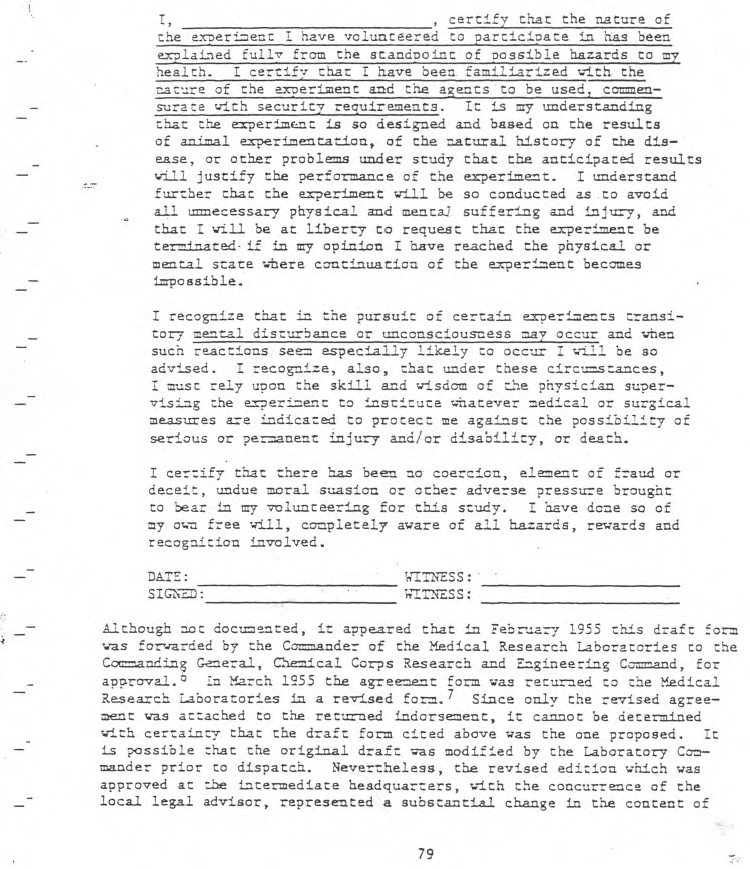
The approximately 7,000 enlisted soldier-volunteers who participated in the program between 1948 and 1975 were drawn from regular Army personnel responding to general solicitations distributed at U.S. Army posts. Verified The recruitment material described the program in general terms — service to one's country, contribution to military medical research, a respite from routine duty assignments — without identifying the specific substances to be tested or the specific risks. Volunteers signed a general consent form. The adequacy of that consent, in particular the adequacy of the information provided to volunteers about specific substances and their known risks, is the principal substantive issue in the subsequent legal and ethical record [2][3].
Most volunteers experienced acute drug effects during their 60-day tours but no documented immediate serious medical injury. A smaller number experienced severe acute reactions; the documented count of deaths during testing is small (the most-cited figure is one, the 1953 death of Harold Blauer in a New York State Psychiatric Institute MKULTRA subproject that drew on Army Chemical Corps materials but did not occur at Edgewood itself; the Edgewood program proper produced no documented in-program death). The long-term health consequences of chemical exposures, particularly the BZ exposures and the LSD exposures, have been the central post-program contested medical question.
The substances tested
The Army's own 1976 IG report and the subsequent 2003 DoD notification process have identified the principal categories of substances tested at Edgewood: Verified
- Nerve agents: sarin (GB), tabun (GA), VX, soman (GD), and various precursors and analogues. Testing was generally at sub-incapacitating doses to characterize physiological response and antidote (atropine, pralidoxime) efficacy [1][4].
- The glycolate BZ (3-quinuclidinyl benzilate): a potent muscarinic antagonist with hallucinogenic and amnestic properties at incapacitating doses, the principal focus of Edgewood's 1960s nonlethal-incapacitant work. Ketchum's research group was the world's most active investigator of BZ in the 1960s and produced the largest body of human-subject data on the agent [5].
- LSD-25: tested at Edgewood under both Army and CIA (MKULTRA) sponsorship beginning in the mid-1950s and continuing through the 1960s. Edgewood subjects were the largest single sample of LSD-exposed individuals in any U.S. government research program [6].
- Mescaline: tested in the early 1950s, less extensively than LSD.
- PCP (phencyclidine): tested in the late 1950s and early 1960s, before its civilian abuse pattern became established.
- Riot-control agents: CS (chlorobenzylidene malononitrile), CR (dibenzoxazepine), and related compounds. Edgewood produced the principal U.S. military exposure data on CS that informed the agent's deployment in Vietnam.
- Approximately 250 to 270 other compounds, including various THC derivatives, atropine analogues, benzodiazepines, opioid analogues, and experimental psychoactives that did not advance to operational interest.
James Ketchum and the medical direction
Dr. James S. Ketchum, a U.S. Army psychiatrist who served at Edgewood from Verified 1961 to 1971, was the principal medical investigator for the BZ and incapacitant research and is the most identifiable individual figure associated with the program. Ketchum's 2006 memoir Chemical Warfare: Secrets Almost Forgotten provides the most detailed first-person account of the program's medical practices, its consent procedures (which Ketchum defended as adequate for their time), and its substantive scientific output [5]. Ketchum's account is significant because it is one of the few sources in which a senior medical figure from the program described the work in detail; it is also contested by some former Edgewood volunteers and by the plaintiffs in the VVA litigation, who have argued that Ketchum's account understates both the severity of acute reactions and the inadequacy of consent.
The connection to MKULTRA and MKOFTEN
The Edgewood program operated in parallel with, and in operational connection to, the CIA's contemporaneous behavioral-control research under MKULTRA (1953–1973) and its successor MKOFTEN, and was preceded by the predecessor BLUEBIRD / ARTICHOKE programs. Verified The institutional connection is documented in MKULTRA subproject records that survived the 1973 destruction: several subprojects involved direct cooperation with Edgewood, including supply of test substances, access to the soldier-volunteer pool, and sharing of test protocols. The MKOFTEN program (1966–1973) involved more extensive Army-CIA cooperation on incapacitating agents, with Edgewood providing the testing facility for compounds the CIA had identified as of operational interest [6][7]. The institutional boundary between the Army and CIA programs was always permeable; the substantive boundary, if any, between defensive and offensive research at Edgewood was contested at the time and remains contested in the historical record.
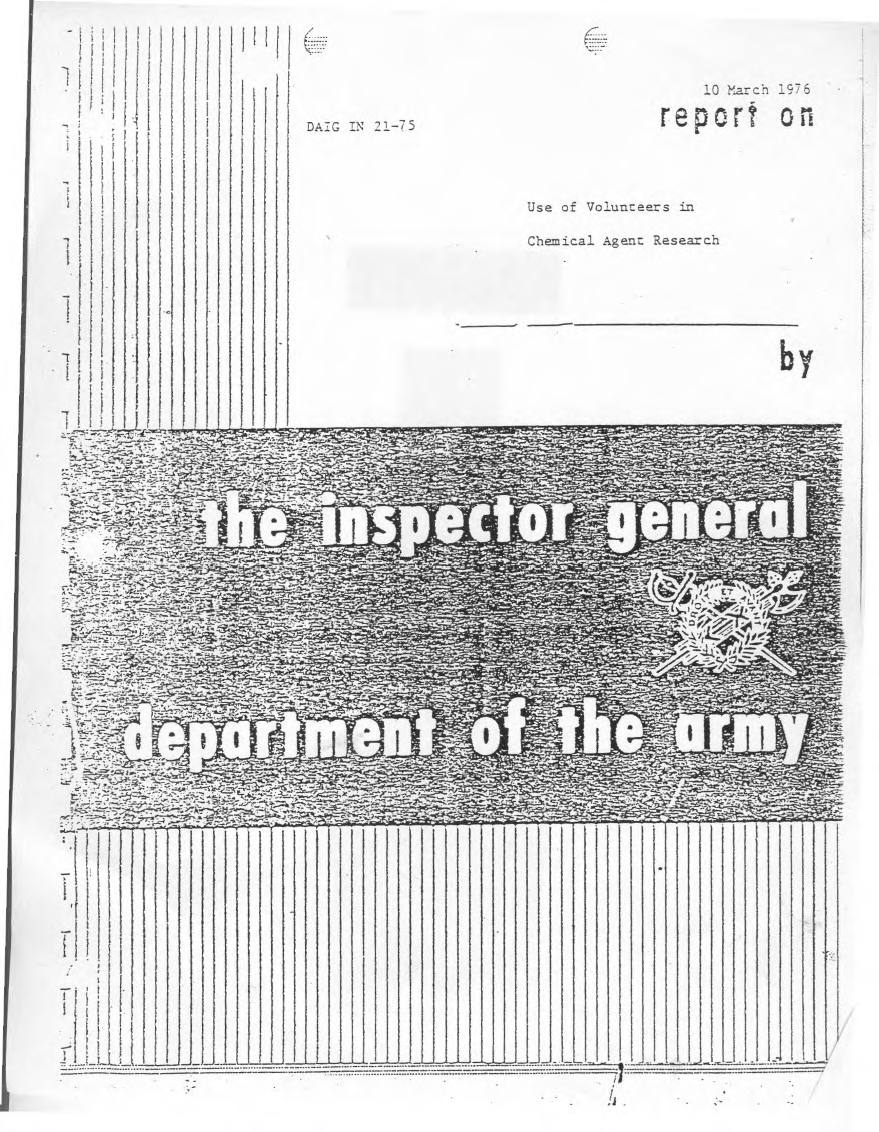
The Department of the Army Inspector General report (DAIG-IN 21-75)
The first major internal review of the Edgewood program is almost universally cited as “the 1975 IG report.” The document's own cover dates it Verified 10 March 1976; the 1975 in general circulation comes from its file number, DAIG-IN 21-75, and has been carried forward by secondary accounts including the Institute of Medicine's bibliography. The sequence is documented on the report's own front matter: the Secretary of the Army directed the research after the 1975 Church Committee hearings and the parallel joint hearings of the Senate Labor and Public Welfare and Judiciary subcommittees; the Vice Chief of Staff, General Walter T. Kerwin Jr., issued the letter of instruction on Verified 21 July 1975; Colonel James R. Taylor and Major William N. Johnson delivered the report nearly eight months later [2].
What the report is matters as much as what it found. Its foreword states the point plainly: “This mission was unlike the usual directive for inquiry or investigation normally assigned to The Inspector General for action. Instead of determining the facts and circumstances of a specific wrong(s) or allegation(s), the mission was to conduct a form of historical research.” The initial scope was limited to LSD and was later enlarged to cover the benzilates and glycolates; arrangements between the Department of Defense and the CIA were explicitly excluded, with a single exception for the total operating cost of the Special Operations Division at Fort Detrick. The researchers interviewed 65 witnesses in 32 cities across 17 states and the District of Columbia. Verified The report contains no findings-and-recommendations chapter — its table of contents runs from a history of chemical warfare to a bibliography — and it did not recommend termination of the volunteer program. The program had already ended before the report was delivered. Accounts describing the IG report as the investigation that shut Edgewood down have the causation backwards [2].
It did nonetheless reach a critical judgement on consent, in its chapter on informed voluntary consent: “Judged solely by the content of the agreement the volunteer was required to sign, the intent of the informed consent policy did not appear to have been fulfilled, since the revised form did not require disclosure of the chemical agent to be used or the full effects of the drug, nor did the publication appended to the volunteer agreement form contain that information.” The same chapter records that Secretary of Defense Wilson's 1953 memorandum — the guidance that adopted the Nuremberg Code as Department of Defense policy and made voluntary consent the condition of all human experimentation — was classified TOP SECRET and Verified was not declassified until August 1975, during the inquiry itself [2].
The 1981 Senate hearings
The Senate Committee on Veterans' Affairs, then chaired by Senator Alan Cranston (D-California), held hearings on the Edgewood program on Verified May 1981. The hearings produced testimony from former volunteers, from Army medical officials including (with some reluctance) Ketchum, and from VA officials regarding the absence at that time of any systematic program for follow-up medical care for former volunteers. The hearings did not produce new legislation directly addressing the Edgewood subjects but established the public record that ultimately supported the 2003 DoD notification and the VVA litigation [8].
The 2003 DoD Force Health Protection notification
In Verified 2003, the Department of Defense launched a Force Health Protection notification program under which the Department of Veterans Affairs and the Army would attempt to identify, contact, and offer medical evaluation to surviving veterans who had participated in the Edgewood program. The notification effort, which continued through the late 2000s, succeeded in contacting several thousand surviving veterans; the program also established that a substantial portion of the original participant records had been lost or destroyed and could not be reconstructed for purposes of individual notification [9].
Vietnam Veterans of America v. CIA (2009–2013)
The Vietnam Veterans of America (VVA), together with eight individual veteran plaintiffs, filed suit in the Northern District of California in Verified January 2009 against the CIA, the U.S. Department of Defense, the Department of the Army, the Department of Veterans Affairs, and the Attorney General. The suit sought declaratory and injunctive relief establishing the federal government's ongoing duty to (1) provide notice to surviving subjects of the Edgewood and related programs; (2) provide medical care for conditions arising from the testing; and (3) release the records necessary for veterans to establish their own exposure history. The case was assigned to Magistrate Judge James Larson and subsequently to District Judge Claudia Wilken [10].
In the principal substantive ruling, issued by Judge Wilken in Verified 2013, the court held that the federal government had an ongoing duty to provide notice to surviving test subjects of newly-identified medical information concerning the substances to which they had been exposed, and ordered specific notification practices. The court declined to order systematic medical care beyond what the VA's existing mechanisms provided, on the ground that medical care for service-connected conditions was already within the VA's statutory mandate. The CIA-specific claims were largely dismissed on jurisdictional grounds. The 2013 ruling is the principal modern legal document on the federal government's continuing obligations to the Edgewood cohort [11].
The official position.
The Army's position, consistently maintained from the 1976 IG report through the 2013 VVA ruling, is that the Edgewood program was a legitimate military medical research enterprise responding to credible Cold War threats — in particular, the established Soviet investment in chemical and incapacitant warfare research and the documented use of nerve agents by various actors in the period. The program's defensive objectives (characterizing agent effects, developing antidotes, training military medical personnel in chemical-casualty management) are uncontroversially within the legitimate scope of military medical research. Claimed
The Army has acknowledged, beginning with the 1976 IG report and consistently since, that the program's consent procedures did not meet either the Nuremberg Code standards that were nominally in force throughout the program's life or the modern human-subjects-research standards that have since been codified. The Army's position is that the consent procedures reflected the standards of military medical research as practiced at the time, that volunteers were not deceived about being in a research program (even where they were not informed of the specific substances), and that the inadequacy of consent is properly addressed through the post-1975 notification, medical-care, and disability-compensation framework rather than through a finding that the program itself was illegitimate [2][9].
The CIA's parallel involvement, through MKULTRA and MKOFTEN, has been acknowledged in substantially less detail. The 1973 destruction of MKULTRA records destroyed a large portion of the CIA's documentary record of its Edgewood-related work; the agency's position in the VVA litigation was that surviving records had been disclosed and that no additional disclosure was required.
The unanswered questions.
The complete substance roster and dose records
The 1976 IG report identified the principal categories of substances tested and established the approximate 7,000-volunteer figure. The complete substance roster — including the approximately 250 to 270 compounds tested in smaller cohorts, several dozen of which were experimental compounds whose chemical identification has not been released — remains incomplete in the public record. Individual-level dose and exposure records for many volunteers were lost or destroyed before the 2003 notification effort and cannot be reconstructed. Disputed
The long-term health consequences
The substantive medical question — what proportion of the Edgewood cohort experienced long-term adverse health consequences attributable to specific exposures — has not been definitively resolved. The cohort is small relative to the statistical power that would be needed to detect modest excess incidence of late-onset conditions, and the absence of complete dose records limits dose-response analysis. The available studies, including the 1980 National Academy of Sciences review and the 2003 DoD follow-up assessments, have generally found no clearly elevated rates of major late-onset conditions, but have noted that the statistical power of these studies is limited [12]. Disputed
The Harold Blauer case and its relation to Edgewood
The most-cited death associated with the Army-CIA chemical-testing complex of the 1950s is Harold Blauer, who died on Verified January 8, 1953 at the New York State Psychiatric Institute after being administered the mescaline analogue EA-1298 (a compound supplied by the Army Chemical Corps under an Army contract with the institute). The Blauer case did not occur at Edgewood Arsenal and is properly identified as an MKULTRA-Army contract death rather than an Edgewood program death; but the substance was an Edgewood-Chemical-Corps product and the case is closely connected institutionally [13]. Whether other deaths in the broader Army-CIA chemical-testing complex of the period should be properly attributed to the Edgewood program is partly a definitional question.
The MKOFTEN material
Project MKOFTEN, the 1966–1973 successor CIA program that involved substantial Army-Edgewood cooperation, was less fully reconstructed in the post-Church-Committee disclosure process than MKULTRA. The surviving MKOFTEN record contains references to operational testing of incapacitants at Edgewood that have not been independently documented in the Army's own files. Unverified
The continuing obligations under the 2013 ruling
The 2013 VVA ruling established the federal government's continuing duty to notify surviving subjects of newly-identified medical information; whether the notification practices subsequently implemented have satisfied that duty is a matter of ongoing legal dispute. Subsequent enforcement motions and counter-motions have continued through 2025; as of 2026, the litigation is technically still active, although the principal substantive issues were resolved in 2013.
Primary material.
The accessible primary record on the Edgewood Arsenal experiments is held at:
- The U.S. Army Center of Military History holds the surviving institutional records of the Medical Research Volunteer Program, including post-1975 records preserved under the IG report's recommendations.
- The CIA's FOIA Reading Room (cia.gov/readingroom) hosts the surviving MKULTRA and MKOFTEN subproject records that document the CIA-Edgewood institutional connection.
- The National Archives (NARA) holds the 1976 Department of the Army Inspector General report and the 1981 Senate Veterans' Affairs Committee hearing record.
- The Vietnam Veterans of America (VVA) holds the litigation record of VVA v. CIA, including discovery materials that document specific Edgewood subprojects.
- The James S. Ketchum papers (privately held until Ketchum's 2019 death; subsequently donated to the U.S. Army Medical Department Center of History and Heritage) include Ketchum's personal records of the BZ research program.
Critical individual documents include: the 1976 IG report itself; the May 1981 Senate Committee on Veterans' Affairs hearing record; the 2003 DoD Force Health Protection notification framework; the VVA complaint of January 2009; and Judge Wilken's 2013 ruling.
The sequence.
- 1947 Nuremberg Code published, establishing voluntary informed consent as the prerequisite for human-subject medical research.
- 1948 Medical Research Volunteer Program begins at Edgewood with initial tabun and captured-German-nerve-agent testing.
- Early 1950s Program expands; LSD-25 enters the test inventory in 1955.
- January 8, 1953 Death of Harold Blauer at the New York State Psychiatric Institute after administration of Army-supplied EA-1298. (Not an Edgewood-site event but the principal death in the broader Army-CIA chemical-testing complex.)
- April 1953 CIA Project MKULTRA authorized; institutional cooperation with Edgewood expands.
- 1961–1971 James Ketchum's principal tenure as medical investigator at Edgewood; BZ becomes the central focus of incapacitant research.
- 1966 CIA Project MKOFTEN authorized, with substantial Army-Edgewood cooperation.
- 1973 CIA Director Richard Helms orders destruction of MKULTRA records.
- 1975 Medical Research Volunteer Program terminated. On 21 July the Vice Chief of Staff directs The Inspector General to reconstruct the history of the Army's chemical-agent testing.
- 1976 Department of the Army Inspector General report on the Edgewood program delivered, 10 March (DAIG-IN 21-75).
- 1976 Church Committee Final Report references the Edgewood-MKULTRA institutional connection.
- 1980 National Academy of Sciences review of long-term health consequences for Edgewood volunteers.
- May 1981 Senate Committee on Veterans' Affairs hearings under Senator Alan Cranston.
- 2003 Department of Defense launches Force Health Protection notification program for surviving Edgewood veterans.
- 2006 James Ketchum publishes Chemical Warfare: Secrets Almost Forgotten.
- January 2009 Vietnam Veterans of America v. CIA filed in the Northern District of California.
- 2013 Judge Claudia Wilken's principal substantive ruling establishes the federal government's continuing duty to notify surviving subjects.
Full bibliography.
- U.S. Army Chemical Corps Medical Research Laboratory. Internal historical summary of the Medical Research Volunteer Program, 1948–1975. Released in connection with the 1976 IG report.
- U.S. Department of the Army, Office of The Inspector General and Auditor General. Use of Volunteers in Chemical Agent Research. DAIG-IN 21-75, 10 March 1976 (prepared by Col. James R. Taylor and Maj. William N. Johnson, pursuant to the Vice Chief of Staff's letter of instruction of 21 July 1975). Widely cited as “the 1975 report” after its file number; the cover and the date stamp both read 10 March 1976. Full scan: Internet Archive.
- Moreno, Jonathan D. Undue Risk: Secret State Experiments on Humans. W. H. Freeman, 1999. The most thorough modern academic treatment of the U.S. government's postwar human-subject research programs, including substantial Edgewood coverage.
- U.S. Army Chemical Corps. Technical reports on nerve agent testing at Edgewood, 1950s–1960s. Various releases under FOIA.
- Ketchum, James S. Chemical Warfare: Secrets Almost Forgotten. ChemBooks, 2006. First-person account by the program's principal 1960s medical investigator.
- Marks, John. The Search for the "Manchurian Candidate": The CIA and Mind Control. Times Books, 1979. The first comprehensive public account of MKULTRA, including the Edgewood institutional connection.
- CIA MKULTRA and MKOFTEN subproject records, partial release through 1977 FOIA recovery by John Marks and subsequent releases. CIA FOIA Reading Room.
- U.S. Senate Committee on Veterans' Affairs. Hearings on the use of veterans in chemical agent research, May 1981. 97th Congress, 1st Session.
- U.S. Department of Defense, Office of the Assistant Secretary of Defense for Health Affairs. Force Health Protection notification framework for Edgewood Arsenal Test Subjects, 2003.
- Vietnam Veterans of America et al. v. Central Intelligence Agency et al., Complaint filed January 7, 2009, Northern District of California, Case No. CV-09-0037-CW.
- Vietnam Veterans of America et al. v. Central Intelligence Agency et al., Order Granting in Part and Denying in Part Plaintiffs' Motion for Partial Summary Judgment, Judge Claudia Wilken, 2013. Northern District of California.
- National Academy of Sciences, Committee on Toxicology. Possible Long-Term Health Effects of Short-Term Exposure to Chemical Agents: Anticholinesterases and Anticholinergics. National Academies Press, 1982 (Volume 1) and 1984 (Volume 2). The principal independent medical review of long-term effects.
- U.S. Court of Claims and subsequent litigation record concerning the death of Harold Blauer at the New York State Psychiatric Institute, January 1953. Various legal references include Barrett v. United States, 689 F.2d 324 (2d Cir. 1982).
- Khatchadourian, Raffi. "Operation Delirium." The New Yorker, December 17, 2012. Profile of James Ketchum and the BZ program; the most-cited modern journalistic treatment.
Frequently asked questions.
What is The Edgewood Arsenal Experiments (1948-1975)?
The US Army Chemical Corps' three-decade program of chemical-warfare-agent and incapacitating-drug testing on ~7,000 soldier-volunteers. LSD, BZ, VX.
What is the current status of this case?
Program ended 1975. Documented in the 1976 Army Inspector General report, 1981 Senate Committee on Veterans' Affairs hearings, the 2003 DoD Force Health Protection notification, and the Vietnam Veterans of America v. CIA litigation (ruled 2013).
When did it take place?
1948 — 1975 (Medical Research Volunteer Program in its acknowledged form)
Where did it take place?
U.S. Army Chemical Corps Medical Research Laboratory, Edgewood Arsenal, Aberdeen Proving Ground, Maryland
Were the Edgewood Arsenal test subjects harmed or compensated?
Many volunteers reported later physical and psychological health problems, and for decades the Army did not systematically track or treat them. In Vietnam Veterans of America v. CIA (ruled 2013), a federal court found the Army had an ongoing duty to notify former test subjects of newly discovered health risks and to provide them related medical care — but the ruling stopped short of ordering broad disability compensation. The full long-term health toll of the roughly 7,000-subject program has never been comprehensively established.