The Indus Valley Script: A Century of Failed Decipherment Across Four Thousand Inscribed Objects.
Across a civilization that covered more ground than contemporary Egypt and Mesopotamia combined, that built planned cities with standardized brick sizes and citywide drainage, and that traded with Mesopotamia across the Arabian Sea, scribes carved approximately four thousand short inscriptions on seals, pottery, and copper tablets. The longest single-surface inscription is about seventeen signs. The average is five. No bilingual text has ever been found. A century of decipherment attempts has produced no widely accepted reading, a long-running argument about whether the symbols are writing at all, and a one-million-dollar prize that as of 2026 remains unclaimed.
AnomalyDesk is reader-supported. Articles may contain affiliate links to books and primary-document collections. Read our full funding disclosure.
Confidence key — claims in this file are tagged as follows Verified primary documentary support · Claimed asserted by a named party, not independently confirmed · Disputed credible sources contradict each other · Unverified we could not substantiate it · how we decide
What the Indus script is, in a paragraph.
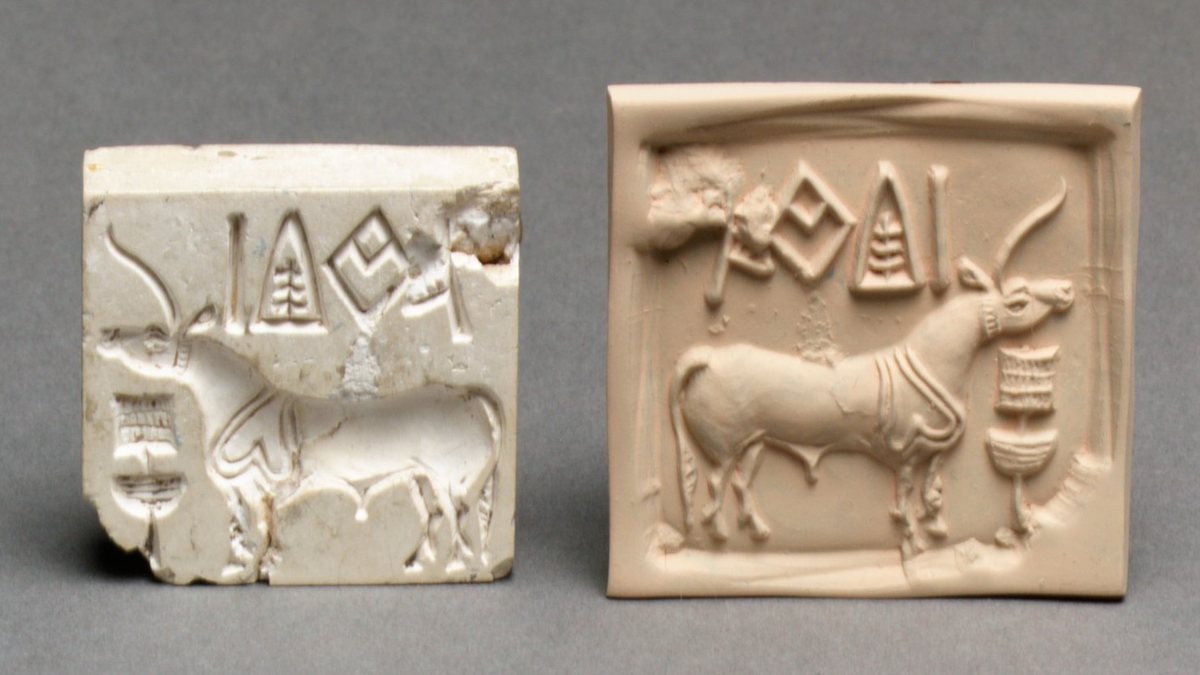
The Indus Valley script is the symbol system carved on artifacts of the Indus Valley Civilization, also known as the Harappan civilization, during its mature period of approximately 2600 to 1900 BCE. The corpus comprises roughly 4,000 surviving inscribed objects, the great majority of them small steatite seals (typically 2.5 to 4 centimeters square) carved with a combination of a central animal figure (most often a bull, a unicorn-like creature, an elephant, or a buffalo) and a short line of text above the animal. Other inscriptions appear on pottery sherds, on copper and bronze tablets, and on miscellaneous small finds. The inscriptions are extremely short: the average is approximately 5 signs, and the longest single-surface inscription runs to about 17 signs, while the well-known board-like panel found at Dholavira (the so-called Dholavira Signboard), consisting of large characters made of inlaid white gypsum or paste, contains 10 large signs. The sign repertoire has been counted at between approximately 400 and 700 distinct forms, with recent statistical work suggesting that the variation collapses to roughly 400 base signs once positional and combinatorial variants are accounted for. The script has been an active object of decipherment attempts since the first publications of seal corpora by John Marshall and Ernest Mackay in the 1930s. More than one hundred separate decipherment claims have been published, with proposed underlying languages including Dravidian (the Asko Parpola hypothesis, dominant in academic circles since the 1970s), Indo-Aryan or Vedic Sanskrit (favored by some Indian scholars, particularly those associated with the Hindu nationalist political tradition), Sumerian, Mundari, and others. A 2004 paper by Steve Farmer, Richard Sproat, and Michael Witzel argued that the symbols are not a script at all but a non-linguistic symbolic system, comparable to the symbols on flags or icons. A 2009 paper by Rajesh Rao and colleagues in Science used conditional-entropy methods to argue that the sign sequences have the statistical signature of natural language. Both positions remain in active debate. As of 2026, no decipherment has been broadly accepted, no bilingual text has been found, the underlying language of the script (if it has one) has not been identified, and the Tamil Nadu state government's 2025 announcement of a one-million-dollar prize for a verifiable decipherment remains unclaimed.
The documented record.
The Indus Valley Civilization in context
The civilization that produced the script was first identified in 1921–1922, when excavations directed by Sir John Marshall of the Archaeological Survey of India revealed Bronze Age urban remains at Harappa (in the Punjab) and Mohenjo-Daro (in Sindh, on the Indus river). Verified Subsequent fieldwork has identified approximately 1,500 Indus sites distributed across what is today Pakistan and northwestern India, from the Makran coast in the southwest to the Ganga-Yamuna doab in the east. The civilization's mature phase, characterized by standardized planned cities, uniform brick dimensions, sophisticated drainage and water management, standardized weights and measures, and the script, runs approximately 2600 to 1900 BCE. The civilization declined and the cities were progressively abandoned in the period 1900–1500 BCE, for reasons that remain debated and that we cover separately. Verified [1][2]
The corpus of inscriptions
The most comprehensive published catalogues of Indus inscriptions are the three-volume Corpus of Indus Seals and Inscriptions edited by Asko Parpola with Indian and Pakistani co-editors (volumes published 1987, 1991, and 2010, with subsequent supplements), and Iravatham Mahadevan's 1977 The Indus Script: Texts, Concordance and Tables. Verified The combined corpus as of the most recent supplements totals approximately 4,000 inscribed objects bearing approximately 5,500 inscriptions (some objects carry inscriptions on multiple faces). The distribution by object type [3]:
- Approximately 60% on stamp seals of steatite or fired-steatite, typically with both a figural design (animal or composite creature) and a short legend.
- Approximately 15% on pottery, usually incised after firing.
- Approximately 12% on copper or bronze tablets, often with longer inscriptions and abstract motifs rather than animal figures.
- The remainder on miscellaneous objects including faience tablets, ivory rods, and the Dholavira Signboard.
The length distribution
The inscriptions are short by the standards of any other early writing system. Verified [3][4]
- The arithmetic mean inscription length is approximately 5 signs.
- The median is 4 to 5 signs.
- Approximately 70% of inscriptions are between 3 and 7 signs.
- The best-known long inscription is the Dholavira Signboard, consisting of 10 large signs, found in 1991 by R. S. Bisht (Archaeological Survey of India) at the citadel gate of Dholavira in Gujarat; the longest single-surface Indus inscription runs to about 17 signs. The signboard's characters are unusually large (each approximately 37 cm tall) and were apparently inlaid with white gypsum or paste on a wooden plank or panel.
Short inscription length is one of the principal obstacles to decipherment: there is no equivalent of the multi-paragraph Egyptian or cuneiform texts that allowed those decipherments. There is also no known bilingual or paral lel-text find — the equivalent of the Rosetta Stone — despite the civilization's documented contact with the contemporary cuneiform-using Mesopotamians.
The sign count
The number of distinct signs in the script has been the subject of long disagreement. Counts in the published literature have ranged from approximately 300 to over 700. The variation reflects different criteria for what counts as a separate sign (versus a positional variant or ligature) and different decisions about damaged or unique forms. Disputed as to the exact figure; Verified that the count is in the range 400–700 on most analyses [3][5].
Statistical work in the 2010s, particularly by Bryan Wells (collaborator on the Parpola corpus) and by Nisha Yadav and colleagues at the Tata Institute, has suggested that the variation collapses to roughly 400 distinct base signs once positional variants and combinatorial cases are handled systematically. A sign repertoire of 400 is too large to be a purely alphabetic or pure abugida system and too small to be a purely logographic system; it is consistent with a logosyllabary, in which signs represent both whole words and syllables, as in Sumerian cuneiform, Egyptian hieroglyphs, and Mayan glyphs. Verified as the structural inference; Claimed as identifying the type definitively.
Sign frequency and positional structure
The script exhibits clear positional structure. Some signs occur predominantly at the beginning of inscriptions; others predominantly at the end. The single most frequent sign (often transcribed as the "jar" or "U-with-handles" sign, ASCII transcription "U1") accounts for roughly 9% of all sign occurrences. The ten most frequent signs together account for roughly 50% of all occurrences. This distribution is comparable to the Zipf-like distribution of word frequencies in natural language. Verified [4][5][6]
The text on most seals is written right to left, on the basis of visual cues including the crowding of final signs against the left edge of the seal. The same texts on the seal impressions (where the seal was used as a stamp) read left to right. The right-to-left direction on the seal itself is the consensus reading direction. Verified
The Asko Parpola work
Asko Parpola, of the University of Helsinki, has been the most sustained academic worker on the Indus script since the late 1960s. Verified Parpola's working hypothesis, developed across a series of monographs from his 1994 Deciphering the Indus Script onward, is that the underlying language of the script is a form of proto-Dravidian, the ancestor of the modern Dravidian language family that today includes Tamil, Telugu, Kannada, Malayalam, and Brahui (the last spoken in modern Pakistan, geographically near the former Indus civilization). Parpola's specific identifications are typically of individual signs as logograms or rebuses representing Dravidian roots; for example, the "fish" sign is identified with the Dravidian root min, which can mean both "fish" and "star," producing a possible reading of certain sign combinations as star-related (zodiac, calendrical, or directional) terms [7]. The Parpola work has produced ongoing publication of the seal corpus, important structural analyses of the sign system, and tentative individual identifications. It has not produced a comprehensive decipherment. The Dravidian hypothesis has been a serious working position in the academic literature but has not been universally accepted.
The Iravatham Mahadevan work
Iravatham Mahadevan, the Indian epigraphist (1930–2018), produced the 1977 concordance of the script that is one of the foundational tools of subsequent analysis. His own interpretive position aligned broadly with Parpola's Dravidian hypothesis, with specific proposed sign-identifications in the Tamil tradition. Verified Mahadevan's later work emphasized the structural and statistical properties of the script over specific linguistic identifications [8].
The Farmer / Sproat / Witzel 2004 challenge
In 2004, Steve Farmer (an independent historian), Richard Sproat (a computational linguist then at the University of Illinois), and Michael Witzel (a Sanskritist at Harvard) published in the Electronic Journal of Vedic Studies a paper titled "The Collapse of the Indus-Script Thesis," arguing that the Indus symbols are not in fact writing — meaning, not a system that encodes spoken language — but a non-linguistic symbolic system. Claimed [9]
The Farmer/Sproat/Witzel argument rests primarily on five observations: (1) the inscriptions are very short, with no example of an extended text; (2) the same signs are used for centuries without obvious diachronic development; (3) approximately one in five signs in the corpus is a unique singleton appearing only once; (4) the sign repertoire of 400–700 is large for a script that has no surviving long texts; and (5) the most direct comparators (Mesopotamian cuneiform, Egyptian hieroglyphs) developed long-text traditions early on, while the Indus material does not. The proposed alternative interpretation is that the Indus symbols functioned similarly to medieval European heraldry or to the painted iconography on flags — conveying identity, religious affiliation, or jurisdictional authority, without encoding the sounds of a language.
The Farmer/Sproat/Witzel paper has been controversial. It has not been accepted as the consensus position, and a number of subsequent papers (notably the Rao et al. 2009 work discussed below) have argued against it on statistical grounds. It has, however, sharpened the debate and forced more careful articulation of what evidence would distinguish "script" from "symbol system." Disputed; the underlying question is not closed.
The Rao et al. 2009 statistical work
In April 2009, Rajesh P. N. Rao (University of Washington), Iravatham Mahadevan, Nisha Yadav (Tata Institute), and colleagues published in Science (vol. 324) a study using conditional entropy methods to compare the Indus sign sequences with both natural-language texts (in Sumerian, Old Tamil, Sanskrit, English) and with non-linguistic symbol systems (DNA sequences, computer code, the symbol systems of Mesopotamian deity lists, the cult-symbols of Vinca culture, and randomly generated control sequences). Verified The conditional entropy of a sequence measures the predictability of the next symbol given the preceding symbol; natural languages have a characteristic entropy profile that distinguishes them from both random sequences and from highly constrained (low-entropy) ritual or symbolic sequences [10].
The Rao et al. result: the Indus sign sequences have a conditional entropy profile statistically indistinguishable from the natural-language samples and statistically distinguishable from the non-linguistic comparators. The paper's authors argued that this constitutes positive evidence that the script encodes linguistic content. Subsequent methodological criticism by Sproat and others has questioned the robustness of the conclusion (arguing that the entropy method does not adequately distinguish certain non-linguistic ordered symbol systems from language), and the Rao group has published responses. The exchange continues. Verified as the technical work; Disputed as to whether the result demonstrates linguistic structure conclusively.
The 2025 Tamil Nadu prize
In January 2025, the government of the Indian state of Tamil Nadu, under Chief Minister M. K. Stalin's DMK government, announced at the Indus Valley Civilisation centenary international seminar a $1 million (approximately ₹8 crore) prize for a verifiable decipherment of the Indus Valley script. Verified The prize protocol requires that any claim be submitted with supporting evidence to a designated review committee of historians and linguists, who will assess whether the proposed decipherment meets the criteria of (1) internal consistency across the corpus, (2) reproducible application to new (i.e., previously unread) inscriptions, and (3) consistency with the archaeological and material context. As of May 2026, no submitted decipherment has been awarded the prize; multiple submissions have been received and are reportedly under review [11].
The decipherment claims and the political stakes.
The Dravidian hypothesis
The most fully developed academic decipherment hypothesis is the Dravidian-language reading associated principally with Asko Parpola and Iravatham Mahadevan. Claimed The hypothesis rests on linguistic geography (the modern Dravidian languages are spoken in southern India, with Brahui spoken as a Dravidian-language outlier in modern Pakistan, consistent with a once-broader pre-Indo-Aryan Dravidian distribution that included the Indus Valley region); on tentative individual sign identifications (the "fish" sign as min, the "u-with-handles" as a possible Dravidian morpheme); and on the demographic-historical reconstruction in which proto-Dravidian speakers occupied the Indus Valley before the Indo-Aryan migrations of the second millennium BCE. Claimed as the leading academic working hypothesis; not generally accepted as a complete decipherment [7][8].
The Indo-Aryan / Sanskrit hypothesis
A competing hypothesis — favored by some Indian scholars, particularly those associated with the Hindu nationalist political tradition aligned with the Bharatiya Janata Party (BJP) and with the broader Out-of-India theory of Indo-European linguistic origin — reads the script as encoding an early form of Sanskrit or proto-Indo-Aryan, supporting the so-called "Aryan continuity" position in which the Indus Valley civilization is identified with the Vedic civilization rather than seen as a separate pre-Vedic culture displaced or absorbed by later Indo-Aryan arrivals. Claimed [12]
This position has been advanced in the academic literature by figures including S. R. Rao (whose 1973 and 1982 decipherments claimed to read the script as proto-Sanskrit and were not generally accepted by international scholars), Subhash Kak (with similar claims), and various others. The position has political stakes in modern Indian discourse because it conflicts with the broader academic consensus that the Indo-Aryan languages and Vedic religion entered the subcontinent from the northwest in the second millennium BCE, after the decline of the Indus cities. The political and the academic dimensions of the dispute have at times been difficult to separate. Disputed at both the linguistic and the political levels.
Other proposed languages
Numerous other proposed decipherments have been published, including readings of the script as Sumerian (Walter Fairservis, partial), Mundari (a member of the Austroasiatic family, indigenous to parts of eastern India), and various other candidates. None has been broadly accepted. The total number of published decipherment claims is in excess of one hundred. Unverified at the level of individual readings.
The non-linguistic-symbol hypothesis
The Farmer/Sproat/Witzel position (discussed above) is that the symbols are not a script at all, and that the question "what language does the script encode" is therefore malformed. Under this view, the symbols functioned as identifying marks (of household, lineage, occupation, deity, jurisdiction, ownership of trade goods), comparable to seals and tokens in other complex societies that did not develop full scripts. Claimed as a substantive alternative; Disputed in light of the Rao et al. statistical results.
The political-religious-nationalist context
The Indus script question is unusual in modern archaeological controversy in that it sits squarely on the fault line of contemporary Indian political identity. The two principal readings — Dravidian and Indo-Aryan/Sanskrit — correspond, in the public political domain, to two competing accounts of who the original civilizational ancestors of the modern Indian state were. The mainstream international academic position is broadly Dravidian or non-committal; the position favored by some Indian government-aligned institutions has at times been the Sanskrit-derived reading. The 2025 Tamil Nadu prize is interesting in this context because Tamil Nadu is a Tamil-speaking (Dravidian-language) state with a strong Dravidian-nationalist political tradition, and the political framing of the prize has emphasized its potential to confirm the Dravidian-substrate hypothesis of the script's underlying language. Whether the prize committee can adjudicate a decipherment claim free of these political considerations is itself an open question. Claimed in various directions; Disputed at the level of how the question is framed.
The 2023 ancient-DNA evidence
Genetic studies published in the late 2010s and early 2020s, notably the 2019 Rakhigarhi ancient-DNA paper by Vagheesh Narasimhan, Vasant Shinde, and colleagues, found that a Mature Harappan individual at Rakhigarhi (Haryana, India) carried predominantly an ancestry component related to Iranian-plateau hunter-gatherers, with no detectable steppe-pastoralist (Indo-European-associated) ancestry. The result is consistent with the Dravidian-substrate hypothesis (in which Indo-Aryan ancestry arrives later, after the Indus decline) and is at least difficult to reconcile with the Aryan-continuity hypothesis without additional auxiliary assumptions. The ancient-DNA work does not decipher the script, but it constrains the broader civilizational context in which any decipherment must be situated. Verified as the genetic finding [13].
The unanswered questions.
The absence of a bilingual
The single most decisive piece of evidence that would resolve the question — a bilingual inscription in which an Indus text and a known-script text (most plausibly Mesopotamian cuneiform) appear together — has never been found. Indus seals have been recovered in Mesopotamian contexts (notably at Ur and other Persian Gulf trading sites), and Mesopotamian cylinder seals have been recovered at Indus sites, but no object has been recovered bearing both scripts in parallel. The Mesopotamian cuneiform record references trade with "Meluhha," which is generally identified with the Indus civilization, but the references are in cuneiform only and do not include Indus transliterations. The absence of a bilingual is the central reason the decipherment problem has resisted the kind of solution that Champollion produced for Egyptian. Verified as the absence.
Longer texts
Whether any longer Indus texts ever existed on perishable materials — on palm-leaf, on cloth, on wood — cannot be determined from the surviving corpus. The climate of the Indus Valley is not conducive to the preservation of organic materials, and the surviving inscriptions are biased toward what would survive on baked clay, fired steatite, and metal. The possibility that the actual Indus literate tradition included extended texts that have not survived is plausible but undemonstrable. Unverified
The function of the seals
The specific function of the typical short inscription — whether it identifies an owner, a deity, a place, a commodity, an authority, or a combination of these — remains debated. The seals are most commonly interpreted as administrative tools (used to mark bales of goods with the owner's or authority's identification) on analogy with comparable practices in Mesopotamia. The longer inscriptions on the Dholavira Signboard and on certain copper tablets may serve different functions. The contextual archaeology of seal use (where seals are found, with what objects, in what association with sealings impressed in clay) is rich but does not on its own resolve the linguistic question.
The relationship of the Indus script to later South Asian scripts
Whether the Indus script is ancestral or related to any later South Asian writing system (Brahmi, Kharoshthi, or precursors to these) is an open question. The standard view is that there is a substantial chronological gap (approximately 1900 BCE to approximately 500 BCE) between the last attested Indus inscriptions and the earliest unambiguous Brahmi inscriptions, during which no writing is securely attested in South Asia. A direct lineage from Indus to Brahmi would require evidence across that gap. Speculative continuities have been proposed but are not generally accepted. Unverified
Whether any decipherment is in principle possible
If the Farmer/Sproat/Witzel position is correct — if the Indus symbols are not a script encoding a language — then the entire decipherment enterprise is misconceived and no decipherment will ever succeed because there is nothing to decipher. If the Rao et al. position is correct — if the symbols do encode linguistic content — then in principle decipherment is possible but in practice may be obstructed indefinitely by the shortness of inscriptions and the absence of a bilingual. Which of these is correct is itself part of what's missing. Disputed
Primary material.
- The Corpus of Indus Seals and Inscriptions — the comprehensive published catalogue of inscribed objects. Volume 1 (1987), Volume 2 (1991), Volume 3 (2010), with subsequent supplements. Edited by Asko Parpola with national co-editors.
- Iravatham Mahadevan's 1977 concordance, The Indus Script: Texts, Concordance and Tables, Memoirs of the Archaeological Survey of India 77, 1977.
- Original artifact collections — held principally at the National Museum of Pakistan (Karachi), the Mohenjo-Daro site museum (Larkana), the Lahore Museum, the Harappa site museum, the National Museum of India (New Delhi), the Allahabad Museum, and the Dholavira site museum.
- The Dholavira Signboard, the longest single inscription, on display at the Dholavira site museum, Gujarat.
- The Rao et al. 2009 paper, "Entropic Evidence for Linguistic Structure in the Indus Script," Science 324, 1165 (April 24, 2009), with subsequent rejoinders.
- The Farmer, Sproat, and Witzel 2004 paper, "The Collapse of the Indus-Script Thesis: The Myth of a Literate Harappan Civilization," Electronic Journal of Vedic Studies 11–2.
The sequence.
- c. 3300 BCE Possible earliest precursor signs at Early Harappan sites (e.g., Harappa).
- c. 2600 BCE Mature Harappan period and full-form Indus script in use.
- c. 2400–1900 BCE Peak production of inscribed seals and tablets across the Indus civilization.
- c. 1900 BCE Beginning of Indus decline; last inscriptions date to the early second millennium BCE.
- 1921–1922 Marshall, Banerji, and Sahni excavate at Harappa and Mohenjo-Daro, revealing the civilization and the first published seals.
- 1931 Marshall publishes Mohenjo-Daro and the Indus Civilization; first systematic catalogue of seals.
- 1969 Asko Parpola begins his career-long Indus script research at the University of Helsinki.
- 1977 Iravatham Mahadevan publishes The Indus Script: Texts, Concordance and Tables.
- 1987 First volume of the Corpus of Indus Seals and Inscriptions (Parpola et al.).
- 1991 R. S. Bisht discovers the Dholavira Signboard at Dholavira, Gujarat.
- 1994 Parpola publishes Deciphering the Indus Script, the most comprehensive statement of the Dravidian hypothesis.
- 2004 Farmer, Sproat, and Witzel publish "The Collapse of the Indus-Script Thesis."
- April 2009 Rao et al. publish entropic analysis in Science.
- 2010 Volume 3 of the Corpus published.
- 2019 Narasimhan et al. publish Rakhigarhi ancient-DNA results bearing on the broader civilizational identity.
- January 2025 Tamil Nadu government announces $1 million decipherment prize.
- 2025–2026 Multiple decipherment submissions reportedly under review; no prize awarded as of May 2026.
Full bibliography.
- Marshall, John (ed.). Mohenjo-Daro and the Indus Civilization, 3 volumes, Arthur Probsthain, 1931. The foundational publication of the civilization and the first systematic catalogue of seals.
- Possehl, Gregory L. The Indus Civilization: A Contemporary Perspective, AltaMira Press, 2002. The standard modern overview.
- Parpola, Asko, B. M. Pande, and Sayid Ghulam Mustafa Shah (eds.). Corpus of Indus Seals and Inscriptions, vol. 1 (1987), vol. 2 (1991), vol. 3 (2010), Suomalainen Tiedeakatemia / Annales Academiae Scientiarum Fennicae, with supplements.
- Mahadevan, Iravatham. The Indus Script: Texts, Concordance and Tables, Memoirs of the Archaeological Survey of India 77, 1977.
- Wells, Bryan K. Epigraphic Approaches to Indus Writing, Oxbow Books, 2011.
- Yadav, Nisha, Hrishikesh Joglekar, Rajesh P. N. Rao, Mayank N. Vahia, Ronojoy Adhikari, and Iravatham Mahadevan. "Statistical analysis of the Indus script using n-grams." PLoS ONE 5(3), e9506 (2010).
- Parpola, Asko. Deciphering the Indus Script, Cambridge University Press, 1994. The most comprehensive statement of the Dravidian-language hypothesis.
- Mahadevan, Iravatham. Early Tamil Epigraphy from the Earliest Times to the Sixth Century A.D., Harvard Oriental Series, 2003. Background on the Tamil/Dravidian linguistic tradition relevant to the script hypothesis.
- Farmer, Steve, Richard Sproat, and Michael Witzel. "The Collapse of the Indus-Script Thesis: The Myth of a Literate Harappan Civilization." Electronic Journal of Vedic Studies 11–2, 19–57 (December 2004).
- Rao, Rajesh P. N., Nisha Yadav, Mayank N. Vahia, Hrishikesh Joglekar, R. Adhikari, and Iravatham Mahadevan. "Entropic Evidence for Linguistic Structure in the Indus Script." Science 324(5931), 1165 (April 24, 2009).
- Government of Tamil Nadu, official announcement of the Indus Script Decipherment Prize, January 2025 (text available via Tamil Nadu state portal and Indian press coverage).
- Rao, S. R. Decipherment of the Indus Script, Asia Publishing House, 1982. Representative of the Indo-Aryan/Sanskrit decipherment tradition.
- Narasimhan, Vagheesh M., Nick Patterson, Priya Moorjani, Niraj Rai, Mark Lipson, Vasant Shinde, et al. "The formation of human populations in South and Central Asia." Science 365(6457), eaat7487 (September 2019).
- Sproat, Richard. "A reply to Rao et al. and Lee et al." Computational Linguistics 36, 451–458 (2010). Methodological critique of the entropy-based argument.
- Vidale, Massimo. The Archaeology of Indus Crafts, IsIAO Reports and Memoirs Series Minor, 2000. On the production context of inscribed objects.
Frequently asked questions.
What is The Indus Valley Script (~2600-1900 BCE)?
The undeciphered writing system of the Harappan civilization. ~4,000 inscribed objects, ~400 base signs, short inscriptions.
What is the current status of this case?
Undeciphered as of 2026. Mainstream archaeological consensus treats the symbols as a genuine writing system whose underlying language has not been identified. A minority position holds that the symbols are not writing at all.
When did it take place?
Mature Harappan, approximately 2600–1900 BCE; with possible precursors in Early Harappan contexts c. 3300–2600 BCE
Where did it take place?
The Indus Valley civilization sites of present-day Pakistan and northwestern India: Mohenjo-Daro, Harappa, Dholavira, Lothal, Rakhigarhi, Ganweriwala, and approximately 1,500 smaller sites