The 1561 Nuremberg Celestial Phenomenon.
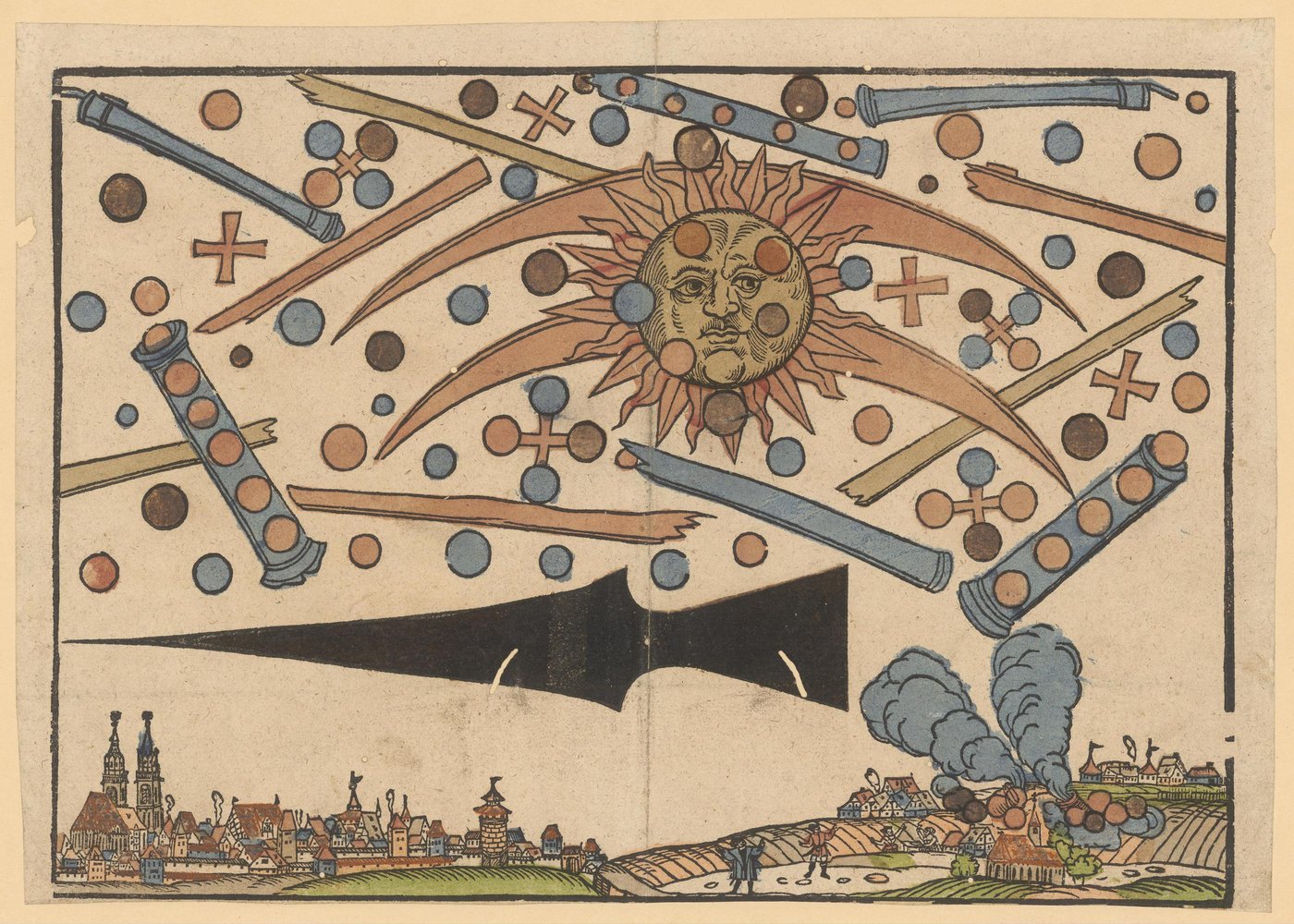
At sunrise on a spring morning in 1561, the citizens of Nuremberg looked up and — according to the broadsheet that recorded it — saw the heavens at war. Out of the rising sun came globes the color of blood, blue and black; long tubes from which more spheres poured; crosses and crescents; and these shapes seemed to dart, collide, and battle one another for about an hour before many of them fell to earth and faded in a great cloud of smoke. To a frightened, deeply religious city, it was a sign from God. To modern UFO writers, it is one of the oldest “sightings” on record. To most who study it carefully, it is the sun playing tricks on the ice in the sky.
AnomalyDesk is reader-supported. Articles may contain affiliate links to books and primary-document collections. Read our full funding disclosure.
Confidence key — claims in this file are tagged as follows Verified primary documentary support · Claimed asserted by a named party, not independently confirmed · Disputed credible sources contradict each other · Unverified we could not substantiate it · how we decide
What the 1561 Nuremberg phenomenon was, in a paragraph.
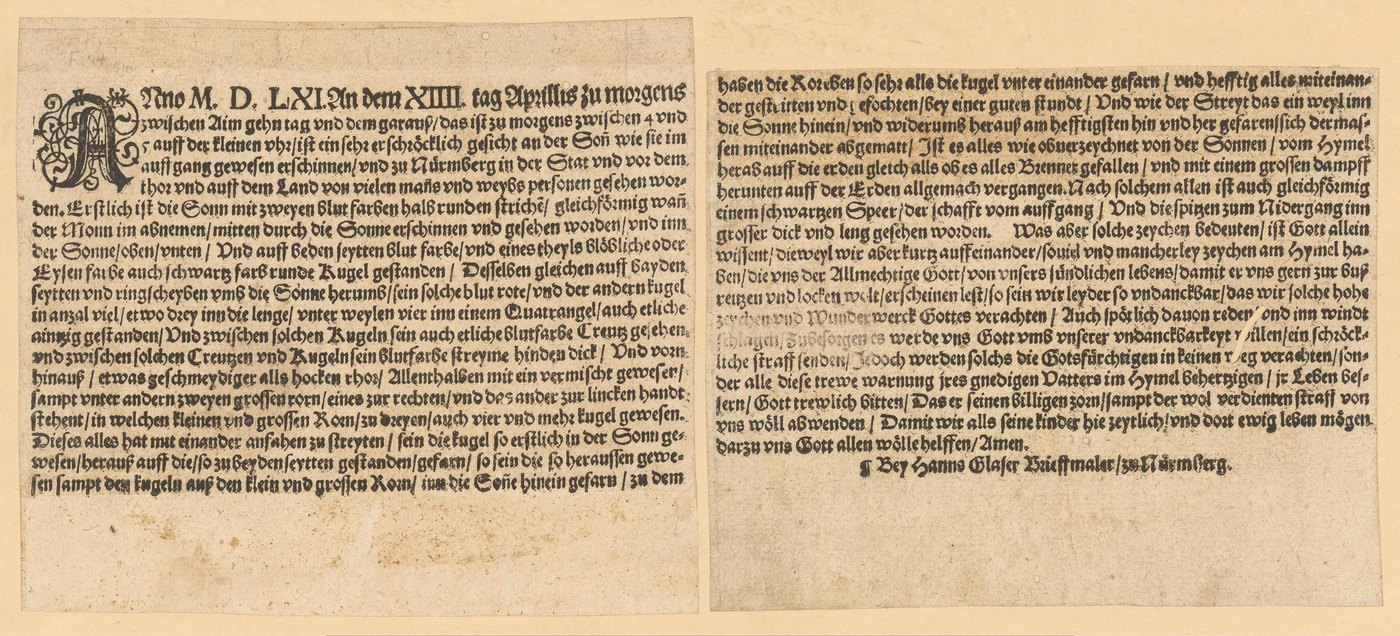
The 1561 Nuremberg celestial phenomenon is an event reported at dawn on April 14, 1561 (Julian) over the imperial city of Nuremberg, known to us almost entirely through a single illustrated broadsheet (a printed news-sheet) produced by Hans Glaser, with a woodcut and accompanying text. According to the broadsheet, around sunrise “numerous” objects appeared in the sky: red, blue, and black globes or spheres; large black cylindrical or tube-shaped forms from which smaller spheres emerged; and crosses and crescent/rod shapes. These objects were described as moving and clashing — the account is often read as depicting the shapes “fighting” one another for roughly an hour — after which many appeared to fall from the sky toward the earth, “as if on fire,” dissolving in smoke or steam; a large black spear- or cross-shaped object was also noted. The broadsheet framed the spectacle in explicitly religious and moral terms: as a divine sign or warning to the people of Nuremberg to repent, in keeping with the early-modern tradition of reading celestial “wonders” (Wunderzeichen) as portents — a genre to which many such broadsheets belonged in a tense Reformation-era Europe. The phenomenon has two main modern interpretations. The dominant scholarly/skeptical view is that the display was an atmospheric-optical event: a complex of sun dogs (parhelia), solar halos, and related ice-crystal phenomena occurring at sunrise, which can produce multiple bright “mock suns,” luminous rings, crosses, and elongated pillars in the sky, and which, seen through the expectations and fears of the time and then stylized by a woodcut artist, could readily be rendered as battling globes, tubes, and crosses; the “falling” and “smoke” may reflect the fading of the display and the artist's dramatization. The minority view, popular in UFO literature (and amplified by writers such as Carl Jung, who discussed the broadsheet in his work on flying saucers as a psychological and symbolic phenomenon), reads the account more literally as a mass sighting of unidentified flying objects — an “aerial battle” of craft. The crucial caveats are that the event is known from essentially one stylized, agenda-laden source whose purpose was moral exhortation, not objective reporting, and that 16th-century broadsheets routinely sensationalized and allegorized natural events. The 1561 Nuremberg phenomenon is therefore best understood as a genuine historical report — people very likely saw an unusual sky — whose most probable cause is atmospheric optics, recast by religious anxiety and the conventions of woodcut news into a celestial battle, and only retrospectively enlisted as an ancient UFO case.
The documented record.
The broadsheet exists
The source is a single news-sheet. Verified The event is recorded in Hans Glaser's 1561 Nuremberg broadsheet, with a woodcut and text describing a dawn sky full of spheres, tubes, crosses, and other shapes that moved and fell [1][2].
The religious framing
It was presented as an omen. Verified The broadsheet interpreted the spectacle as a divine sign calling for repentance, in line with the early-modern Wunderzeichen (wonder-sign) genre of portent literature [2][3].
The atmospheric-optics explanation
The leading natural account. Disputed Most analysts attribute the display to sun dogs, halos, and related ice-crystal optical phenomena at sunrise, stylized by the artist and the era's expectations into “battling” objects [1][3].
The single-source problem
The evidence is thin and shaped. Verified The account derives essentially from one stylized, moralizing broadsheet, not from independent objective records, which limits how literally its details can be taken [2][3].
The competing positions.
The UFO/anomalist reading takes the broadsheet relatively literally as a mass sighting of structured flying objects engaged in an aerial battle — an early instance of the same phenomenon reported in the modern era. Claimed It is frequently paired with the 1566 Basel event as evidence of pre-modern UFOs, and was famously discussed (symbolically) by Carl Jung [4].
The mainstream position is that the spectacle was an atmospheric-optical display — sun dogs, halos, and pillars — interpreted as a religious portent and dramatized in a woodcut, with no need for craft. Disputed This archive treats the 1561 Nuremberg phenomenon as most likely an ice-crystal optical event filtered through Reformation-era anxiety and the sensational broadsheet medium, regards the literal “UFO battle” reading as unsupported by the single, agenda-driven source, and notes that the case's real interest is as a document of how people once recorded and explained the strange in the sky [1][3].
The unanswered questions.
Independent corroboration
There is essentially one source. Unverified Without independent contemporary accounts, the precise reality behind the broadsheet's stylized description cannot be reconstructed [2][3].
How much is artistic license
The woodcut shapes the “facts.” Disputed How far the “battle,” the falling objects, and the specific forms reflect what was seen versus the artist's dramatization and the portent genre is unresolved [1][2].
The exact optical cause
The specific display can't be pinned down. Disputed Which combination of halos, parhelia, and pillars produced the appearance — if atmospheric optics is correct — cannot be determined at this remove [3].
Primary material.
The accessible record on the 1561 Nuremberg phenomenon is held principally in these sources:
- The Hans Glaser broadsheet of 1561 (woodcut and text), held in collections including the Zurich Central Library.
- Scholarship on the Wunderzeichen broadsheet genre and Reformation-era portent literature.
- Atmospheric-optics literature on sun dogs, halos, and related ice-crystal phenomena.
- Carl Jung's discussion of the broadsheet in Flying Saucers: A Modern Myth of Things Seen in the Skies.
- Modern UFO and skeptical analyses of the case.
Critical individual sources include: the broadsheet itself; the optics literature; and the broadsheet-genre scholarship.
The sequence.
- Dawn, April 14, 1561 Nuremberg residents reportedly see a sky full of spheres, tubes, and crosses that move and fall.
- 1561 Hans Glaser produces the illustrated broadsheet recording and interpreting the event as a divine sign.
- Early-modern era The sheet circulates within the Wunderzeichen portent tradition.
- 1958 Carl Jung discusses the broadsheet in his book on flying-saucer mythology.
- Modern era The case is cited as an early UFO report; analysts favor an atmospheric-optics explanation.
Full bibliography.
- Hans Glaser, the 1561 Nuremberg broadsheet (woodcut and text), Zentralbibliothek Zürich and other collections.
- Scholarship on the Wunderzeichen broadsheet genre and Reformation-era portent literature.
- Atmospheric-optics literature on sun dogs, halos, and parhelia.
- Carl Jung, Flying Saucers: A Modern Myth of Things Seen in the Skies (1958), and modern analyses of the case.
Frequently asked questions.
What happened in Nuremberg in 1561?
At dawn on April 14, 1561, residents of Nuremberg reported seeing the sky fill with globes, crosses, cylindrical “tubes,” and blood-red and black shapes that seemed to move, collide, and “fight” before some fell to earth and a great black spear-like form appeared. The event was recorded soon after in an illustrated news broadsheet by Hans Glaser, which is the sole source for it.
Was the 1561 Nuremberg event a UFO battle?
That's a modern reading, and not the most likely one. The broadsheet's own framing was religious — a divine warning — not a report of machines. It is often cited today as an “aerial battle of UFOs,” but there is no evidence of craft; the imagery reflects how a 16th-century audience interpreted a strange sky.
What really caused the 1561 Nuremberg sighting?
The leading explanation is an unusual atmospheric-optical display — sun dogs (parhelia), halos, and related ice-crystal effects around the low dawn sun — whose multiple bright spots and arcs were seen through an apocalyptic, religiously charged lens and rendered dramatically in the woodcut. It is best understood as a real sky event, sincerely reported and vividly moralized, rather than a literal battle.
What is the current status of this case?
Open but most likely explained. The account rests on a single 1561 news-sheet; the atmospheric-optics reading is the mainstream explanation, with a minority treating it as an early UFO report.
Who recorded the 1561 Nuremberg celestial phenomenon?
A single man, in a single document — which is the central limitation of the whole case. The account comes from an illustrated broadsheet printed by Hans Glaser in Nuremberg in 1561, pairing a woodcut of the sky over the city with a block of explanatory text. Copies survive in collections including the Zentralbibliothek Zürich. Glaser was not an eyewitness-reporter in the modern sense: the broadsheet belongs to the Wunderzeichen genre — printed “wonder signs” that presented unusual events as portents carrying religious meaning, produced commercially for a Reformation-era public that read the sky theologically. Everything later writers have said about 1561, including the modern UFO reading, descends from this one sheet.