The Roswell Incident: One Press Release, Two Retractions, and a Forty-Year Silence
On July 8, 1947, the Roswell Army Air Field's public information officer announced the recovery of a "flying disc." Hours later, the explanation changed to a weather balloon. The actual answer, declassified forty-seven years afterward, was Project Mogul. Whether that's the whole answer is the case that remains open.
AnomalyDesk is reader-supported. Articles may contain affiliate links to books and primary-document collections. Read our full funding disclosure.
Confidence key — claims in this file are tagged as follows Verified primary documentary support · Claimed asserted by a named party, not independently confirmed · Disputed credible sources contradict each other · Unverified we could not substantiate it · how we decide
What Roswell was, in a paragraph.
In late June or early July 1947, ranch foreman W.W. "Mac" Brazel found a debris field on the Foster Ranch, approximately 75 miles northwest of the city of Roswell, New Mexico. The material consisted of foil-like sheeting, wood-like sticks with strange markings, and rubber-like fragments scattered across roughly three-quarters of a square mile. Brazel collected some of the material and on July 7 reported it to the Chaves County sheriff, who contacted the Roswell Army Air Field. On July 8, 1947, RAAF's public information officer Lt. Walter Haut issued a press release announcing that the field had "come into possession of a flying disc." The story ran on the front page of the Roswell Daily Record that afternoon. Within hours, Brigadier General Roger Ramey of the Eighth Air Force in Fort Worth retracted the announcement: the material was a weather balloon and its rawin radar target. For 47 years, that was the public story. In 1994, the US Air Force released a comprehensive review concluding that the material was actually part of Project Mogul — a then-top-secret high-altitude balloon train designed to detect the acoustic signatures of Soviet atmospheric nuclear tests. The 1994 report (and a 1997 follow-up specifically addressing the "alien bodies" claims that had developed in the intervening decades) constitutes the current official position. Some elements of the case — particularly the witness testimony of Major Jesse Marcel, the Roswell intelligence officer who handled the initial recovery — continue to be contested.
The documented record.
The Brazel discovery
W.W. "Mac" Brazel was the foreman of the Foster Ranch, a remote sheep-and-cattle operation in Lincoln County, New Mexico. He found the material during a routine pasture check, gathered some of it, and stored it before reporting it several days later. Verified His one contemporary account is an interview published in the Roswell Daily Record on 9 July 1947 under the headline “Harassed Rancher Who Located ‘Saucer’ Sorry He Told About It” — the day after the paper had carried the RAAF press release [13].
What Brazel actually described is worth setting out exactly, because it is not what the case is now remembered for. Verified He listed “rubber strips, tinfoil, a rather tough paper and sticks” scattered over about 200 yards. Bundled up, the foil, paper, tape and sticks made a package roughly three feet long and seven or eight inches thick; the rubber made another about eighteen to twenty inches long. The whole lot weighed, he estimated, “maybe five pounds.” The construction included Scotch tape and a decorative tape printed with flowers, and one paper fin had been glued to tinfoil. As for markings: “There were no words to be found anywhere on the instrument, although there were letters on some of the parts.” And, flatly: there was “no sign of any metal in the area which might have been used for an engine” [13].
A correction. Earlier versions of this file dated that interview to 8 July and said Brazel had described “foil-like material with a metallic appearance that could be crumpled and would return to its original shape.” Disputed That description is not in his 1947 interview. The crumple-and-recover foil enters the record through Jesse Marcel’s testimony from 1978 onward, three decades later. Attributing it to the contemporary source inverted the very distinction this file exists to draw — between what was written down in 1947 and what was recalled after 1978 — and it removed the most striking thing in Brazel’s account, which is how ordinary and how light the debris was.
None of which means Brazel endorsed the official explanation. The same interview closes: Verified “I am sure that what I found was not any weather observation balloon… But if I find anything else besides a bomb they are going to have a hard time getting me to say anything about it” [13]. The contemporary witness rejected the weather-balloon story and described five pounds of tape and sticks. Both halves of that are in the same article, and accounts of this case tend to quote one and not the other.
The RAAF press release of July 8, 1947
The RAAF press release, drafted by 1st Lt. Walter Haut at the direction of base commander Col. William H. Blanchard, stated: "The many rumors regarding the flying disc became a reality yesterday when the intelligence office of the 509th Bomb Group of the Eighth Air Force, Roswell Army Air Field, was fortunate enough to gain possession of a disc through the cooperation of one of the local ranchers and the sheriff's office of Chaves County. The flying object landed on a ranch near Roswell sometime last week..." [2] Verified
This is the only US military press release in history to formally claim the recovery of a "flying disc." That it was issued at all is, regardless of the underlying material's nature, a documented fact.
The retraction and the Fort Worth photographs
The press release was picked up by wire services within hours. By that evening, Brig. Gen. Roger M. Ramey at Eighth Air Force headquarters in Fort Worth had taken physical possession of the debris (or some portion of it — this is one of the contested points) and was holding a follow-up press conference. Ramey identified the material as a weather balloon, specifically a "rawin" radar reflector target attached to a standard weather balloon, and presented Maj. Jesse Marcel and the balloon-target debris for photographs taken by Fort Worth Star-Telegram photographer J. Bond Johnson. The photographs are extant. The debris visible in them is consistent with a balloon-and-target rawin assembly [3]. Verified
Major Jesse Marcel
Maj. Jesse Marcel was the 509th Bomb Group's intelligence officer at RAAF in July 1947. He was directly involved in the initial recovery of the debris from Brazel's ranch and the transport of material to Fort Worth. He retired from the Air Force in 1958 with the rank of lieutenant colonel. In 1978 — thirty-one years after the incident — Marcel gave an interview to UFO researcher Stanton Friedman in which he stated that the material he handled was not, in his view, consistent with a weather balloon. He described foil that could not be crumpled or burned, structural members that could not be cut, and "writing" of some kind on parts of the debris [4]. Verified Marcel made similar statements in subsequent interviews until his death in 1986.
Marcel's testimony is one of the most significant pieces of evidence cited by those who reject the weather-balloon and Project Mogul explanations. It is also one of the most-debated, because it is a single witness's recollection given three decades after the event, in the absence of physical material, after he had read substantial UFO literature, and after his own son had become an active UFO researcher.
Project Mogul: what it actually was
Project Mogul (1947–1949) was a top-secret US Army Air Forces program designed to detect the acoustic signature of Soviet atmospheric nuclear tests by suspending sensitive microphones at high altitude in the stable layer of the lower stratosphere, where sound waves from a distant detonation could propagate over thousands of miles. Because long-range radar and seismic detection were inadequate to detect early Soviet nuclear tests at the time, Mogul provided a unique capability [5].
Each Mogul flight consisted of a "train" of up to two dozen neoprene balloons strung together at intervals of 20 feet, suspended below were sonobuoy-derived acoustic sensors, radar reflectors (rawin targets), batteries, transmitters, and parachutes for recovery. A complete train was 600–700 feet long. The neoprene balloons would fail and fall away over time, but the radar targets and other components could land in coherent debris fields. Verified
The launch records of Mogul show a flight (Flight No. 4) launched from Alamogordo Army Air Field on June 4, 1947, the radar track of which was lost over the area east of Alamogordo at approximately the latitude and on a trajectory consistent with the Foster Ranch location. This flight is the strongest specific candidate for the source of the Brazel debris in the 1994 Air Force analysis [5].
What the GAO actually found
The audit is usually mentioned in passing and then dropped — and often blurred with what prompted the Air Force reviews, which was Schiff’s 1993 records request, not the written findings that came two years later. It is worth reading on its own, because it is the only investigation of the case carried out by people whose job was records rather than aircraft. Verified The result, Government Records: Results of a Search for Records Concerning the 1947 Crash Near Roswell, New Mexico (GAO/NSIAD-95-187), was delivered to Schiff in July 1995. It is twenty-six pages long and we host it in full.
Its central finding is the one that entered the literature and never left: Verified “RAAF administrative records (from Mar. 1945 through Dec. 1949) and RAAF outgoing messages (from Oct. 1946 through Dec. 1949) were destroyed. The document disposition form does not indicate what organization or person destroyed the records and when or under what authority the records were destroyed” [11]. Records covering the exact base, across the exact period, are gone, and the paperwork does not say who removed them or on whose authority. That is not a rumour; it is a finding by the Congress's own auditors.
The sentence that follows it in the same report travels much less often. Verified GAO asked the Chief Archivist of the National Personnel Records Center about the gap. He said the disposition form “did not properly indicate the authority under which the disposal action was taken,” and that “from his personal experience, many of the Air Force organizational records covering this time period were destroyed without entering a citation for the governing disposition authority.” The auditors then did what auditors do, and checked: “Our review of records control forms showing the destruction of other records — including outgoing RAAF messages for 1950 — supports the Chief Archivist's viewpoint” [11].
Both halves are true at once, and the case turns on holding them together. The destruction is real and it is undocumented. It is also, on the evidence GAO gathered, what routinely happened to Air Force administrative records of that era — including records for 1950, a year in which nothing is alleged to have happened at all. A gap that appears wherever you look is weak evidence about the one place you were looking.
The two surviving documents
Verified The auditors' search “yielded two records originating in 1947 — a July 1947 history report by the combined 509th Bomb Group and RAAF and an FBI teletype message dated July 8, 1947” [11]. That is the entire contemporaneous federal paper trail they could locate for the most famous UFO case in history.
The unit history is the more revealing of the two, because it was written for internal consumption rather than the press. It records that the RAAF public information office “was kept quite busy . . . answering inquiries on the 'flying disc,' which was reported to be in [the] possession of the 509th Bomb Group. The object turned out to be a radar tracking balloon.” Verified GAO notes that the base's commanding officer certified by his signature that the report was a complete and accurate account of the unit's activities that month [11]. A base concealing a recovered craft would have to have falsified its own routine internal history in the same week, and then filed it.
The air-accident check, and why absence proves little
The most useful thing in the GAO report is also the least quoted, because it undercuts a piece of reasoning both camps rely on. Verified Army regulations in 1947 required air accident reports to be kept permanently. GAO identified four Army Air Forces accidents in New Mexico in July 1947, all involving military aircraft, and all occurring after July 8 — the date the RAAF announced a “flying disc.” The Navy reported none [11].
Then the qualifier: Air Force officials told the auditors that under the record-keeping rules then in force, the crash of a weather balloon required no report at all [11]. Verified This is why the absence of an accident report for the Foster Ranch debris is not the clue it is often presented as. If the object was a balloon train, no report was required and none should exist. If it was something else, the relevant records were in the categories that were destroyed. The documentary silence is consistent with both readings, which means it discriminates between neither — and an argument that survives every possible outcome is not an argument about the evidence.
The 1994 USAF Report
In 1993, Representative Steven Schiff of New Mexico requested a General Accounting Office investigation of Roswell-related federal records. The GAO inquiry triggered an internal Air Force review led by Col. Richard Weaver. The resulting report, "The Roswell Report: Fact vs. Fiction in the New Mexico Desert," was released in July 1994. The report's conclusion: the debris found by Brazel was almost certainly from Project Mogul, specifically Flight No. 4 [6]. Verified
The 1994 report explicitly addressed why the rapid weather-balloon retraction had been a deception: Mogul itself was a classified program. RAAF personnel who handled the material initially likely did not know what Mogul was; the cover story used at the time was the only one available without revealing the classified program.
The 1997 USAF follow-up
By the mid-1990s, the Roswell narrative had expanded substantially beyond the original debris-field story to include claims of recovered "alien bodies." The Air Force issued a second report in 1997, "The Roswell Report: Case Closed," specifically addressing these claims. The report attributed the "bodies" testimony to a conflation of three real but unrelated programs: anthropomorphic test dummies dropped from high altitude in the 1953–1959 period (Operation High Dive), a 1956 KC-97 aircraft crash with eleven fatalities in the same general area, and a 1959 manned high-altitude balloon accident [7].
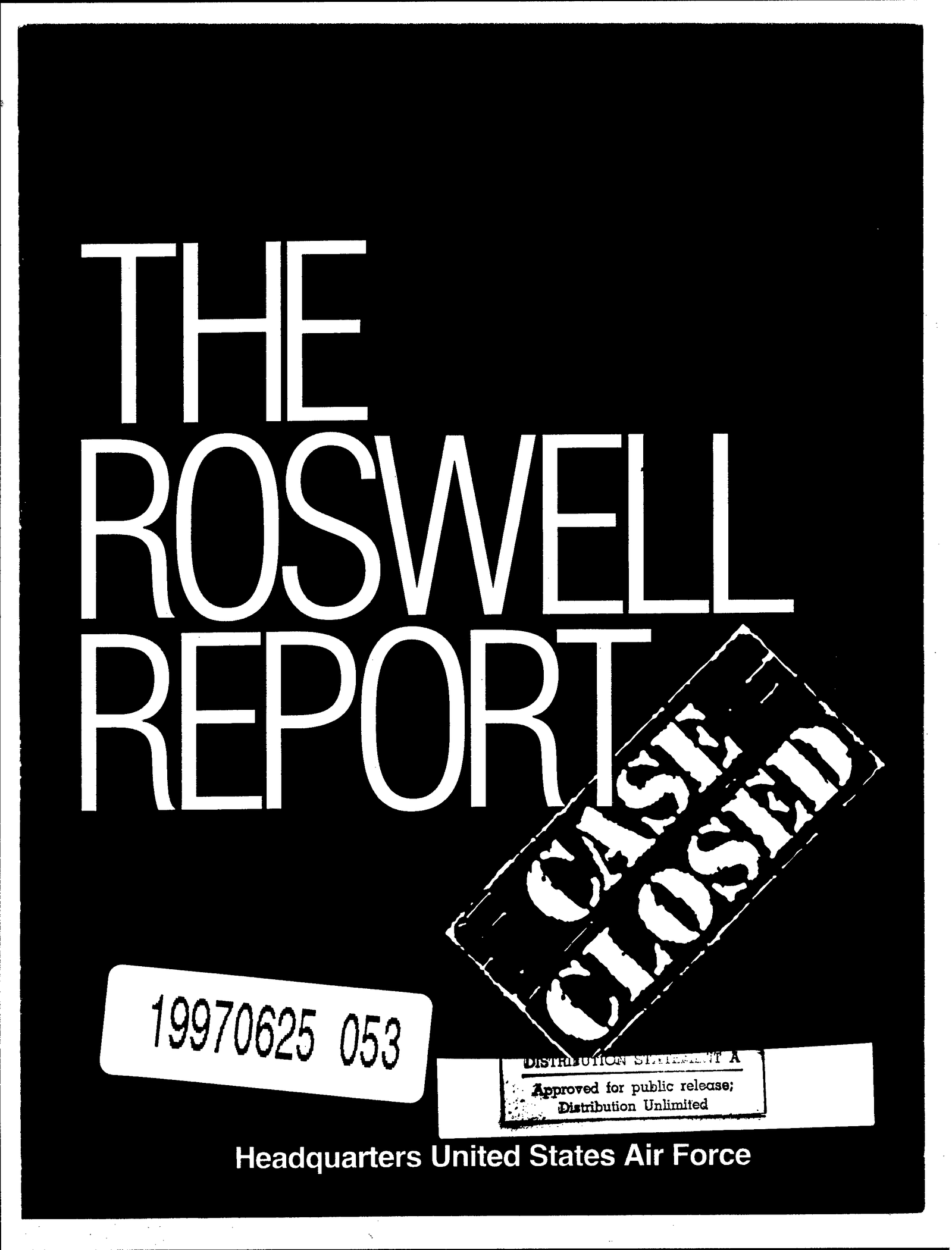
Source: Headquarters United States Air Force, The Roswell Report: Case Closed, U.S. Government Printing Office, 1997, cover. Public domain — work of the U.S. federal government. Rendered from page 1 of the copy hosted on this site; the scan carries no text layer, so this is the page image itself.
The 1997 report acknowledged that some of the events it identified occurred years after 1947, which it attributed to the unreliability of decades-later witness recall and to the conflation of separate incidents in popular accounts.
The 2024 AARO historical report
The Department of Defense's All-domain Anomaly Resolution Office (AARO) included Roswell in the scope of its 2024 historical review (Volume I). The AARO report did not provide new physical evidence on the case but reviewed records held by DoD and concluded that no DoD-held records support the recovery of any extraterrestrial craft at Roswell or elsewhere. Claimed AARO's Volume II, addressing additional case material, is pending [8].
The non-Mogul accounts.
The "extraterrestrial craft" interpretation of Roswell developed primarily after 1978, beginning with Stanton Friedman's interviews with Jesse Marcel and growing through Charles Berlitz and William Moore's 1980 book The Roswell Incident [9]. The accumulated body of claim, drawn from multiple witnesses interviewed decades after 1947, asserts:
- That the debris was from a craft of non-terrestrial origin, with material properties (memory foil, indestructible structural members, undecipherable symbols) inconsistent with 1947 aerospace technology.
- That bodies of small non-human beings were recovered from a second site separate from Brazel's ranch.
- That a deliberate cover-up, ongoing for decades, suppressed the true nature of the recovery.
The provenance of these claims is heavily weighted toward late-life recollections given by aging witnesses to active UFO researchers. The reliability of such testimony, where it conflicts with contemporary 1947 documentation, is the question on which the case turns.
Notable witness accounts that have shaped the alien-recovery narrative include those of Glenn Dennis (mortician, claimed in 1989 to have received an unusual call from RAAF about child-sized caskets); Gerald Anderson (claimed in 1990 to have witnessed an alien crash site as a child); and a document attributed to Walter Haut describing wreckage and bodies — signed in 2002, withheld by agreement with his family until after his death on 15 December 2005, and finally published in 2007 in Schmitt and Carey’s Witness to Roswell. Disputed (This file previously gave 2005 as the release year; 2005 is when Haut died, not when the document appeared. Its characterisation as an “affidavit” has itself been contested, and Haut had signed an earlier, materially different affidavit in 1993.) Each of these accounts has been the subject of extensive critical evaluation — most systematically by Karl Pflock, whose position is worth stating because it is unusual: a CIA intelligence officer from 1966 to 1972, later Reagan-administration Deputy Assistant Secretary of Defense for Operational Test and Evaluation, and a member of the Mutual UFO Network, who opened his 2001 book by describing himself as “a ‘pro-UFOlogist’… I am also an ‘anti-Roswellian.’” He investigated the case as a believer in the wider subject and concluded against this instance of it [10]. The Anderson testimony is now widely treated as fabricated, while the Haut affidavit's provenance and Haut's earlier consistent contradictory statements have made the document highly contested.
The unanswered questions.
The 1947 retraction's exact mechanics
The retraction from "flying disc" to "weather balloon" happened within hours on July 8, 1947. The internal correspondence that drove that retraction — specifically, the communications between RAAF, Eighth Air Force, and higher echelons of the Army Air Forces — is not comprehensively documented in the released archival record. Whether the retraction was driven by the recognition that the material was Mogul (and thus needed cover) or by some other factor is plausibly the former, but not directly documented.
Why Project Mogul wasn't acknowledged in 1947
The original RAAF press release describes a "flying disc," not a weather balloon. The retraction describes a weather balloon, not Mogul. The pattern suggests RAAF personnel themselves did not know what Mogul was. The 1994 Air Force report acknowledges this but does not provide a complete reconstruction of who knew what at which echelon during the critical 24-hour window.
Marcel's testimony
Maj. Jesse Marcel's 1978–1986 statements that the material he handled was inconsistent with any balloon are the single most-cited piece of witness evidence against the Mogul explanation. The 1994 report addresses Marcel's testimony by noting the time gap and possible influence of UFO literature, but does not directly refute the specific physical-property claims Marcel made. Whether Marcel's 1978-era recollection is reliable as to the physical properties of the material he handled in 1947, or whether it reflects three decades of memory revision, is not resolvable from the documentary record. The material itself was not preserved.
The Ramey memo
A photograph taken during Brig. Gen. Ramey's July 8, 1947 Fort Worth press conference shows Ramey holding a partially-visible telex or note. Several enthusiasts have analyzed enlargements of this photograph and proposed various readings of the partial text, including phrases interpreted as referring to "victims of the wreck" or to specific recovery details. The image resolution is genuinely too low to resolve the question; no two independent analysts have produced identical transcriptions. The original document, if it exists in archives, has not been located.
The expansion of the narrative after 1978
From 1947 to 1978, Roswell was essentially a closed case: the public record was the weather-balloon retraction and almost nothing else. From 1978 onward, the narrative expanded substantially, eventually generating dozens of additional named witnesses, multiple alleged crash sites, recovered-body claims, and an institutional cover-up apparatus. The proportion of this expansion that reflects long-suppressed truth versus the proportion that reflects the natural growth of a story attracting reinterpretation cannot be determined from the surviving primary record. Different historians and researchers reach quite different conclusions about how to weight the late-developed testimony. The fullest attempt to treat that growth as a subject in its own right — rather than as evidence for or against a crash — is the Smithsonian Institution Press study by the Brandeis anthropologists Benson Saler and Charles A. Ziegler, written with Charles B. Moore — the same Moore who helped launch the Mogul balloons in 1947 and who appears at [5] above as a participant. It reads the post-1978 expansion as the formation of a modern American myth and traces which elements entered the story when [12].
Primary material.
Material from 1947 itself:
- The RAAF press release of July 8, 1947, drafted by Lt. Walter Haut.
- The Roswell Daily Record's July 8, 1947 front-page article based on the press release.
- The Brazel interview in the Daily Record, July 9, 1947.
- Photographs from Fort Worth taken by J. Bond Johnson during the Ramey press conference, including images of Marcel with debris and Ramey holding the contested memo.
- The wire-service coverage of July 8–9, 1947 documenting the initial announcement and retraction.
Material on Project Mogul:
- The Mogul project records, including flight launch logs, declassified and held at NARA. Project records were transferred from Air Materiel Command to historical archives in the late 1980s.
- Mogul technical specifications from declassified Air Materiel Command documentation.
Hosted here in full. Two of the documents below are on this site rather than described at second hand: the 1995 GAO records search (26 pages, searchable) and the Air Force's 1997 Case Closed report (232 pages, page-image scan). Both are U.S. federal government works in the public domain, and the second carries the Air Force's own release authorisation on its cover.
Material on the 1994 and 1997 reviews:
- "The Roswell Report: Fact vs. Fiction in the New Mexico Desert" (1994), Headquarters United States Air Force.
- "The Roswell Report: Case Closed" (1997), Headquarters United States Air Force.
- GAO report "Government Records: Results of a Search for Records Concerning the 1947 Crash Near Roswell, New Mexico" (1995).
Material on the witness expansion:
- Friedman, Stanton T. (multiple). Interview tapes and transcripts of Marcel and others, in Friedman's personal archive (partially deposited at the Roswell UFO Museum).
- Berlitz, Charles & Moore, William L. The Roswell Incident (1980) — the book that carried the extraterrestrial reading to a mass audience [9].
- Various affidavits in private collections and at the International UFO Museum and Research Center in Roswell.
The sequence.
- June 4, 1947 Project Mogul Flight No. 4 launched from Alamogordo AAF. Radar track lost over eastern New Mexico.
- June 14, 1947 (estimated) Brazel finds debris on Foster Ranch.
- July 5, 1947 (estimated) Brazel travels into Corona; later returns to gather more material.
- July 7, 1947 Brazel reports debris to Chaves County Sheriff George Wilcox.
- July 8, 1947 (morning) Wilcox contacts RAAF. Marcel and Capt. Sheridan Cavitt go to Foster Ranch with Brazel.
- July 8, 1947 (early afternoon) Col. Blanchard authorizes Lt. Walter Haut to issue the "flying disc" press release.
- July 8, 1947 (evening) Brig. Gen. Ramey holds Fort Worth press conference. Material identified as weather balloon and rawin target. Johnson photographs taken.
- July 9, 1947 Brazel interviewed by the Roswell Daily Record (“Harassed Rancher Who Located ‘Saucer’ Sorry He Told About It”). He describes about five pounds of tinfoil, paper, tape, sticks and rubber and no metal — but says “what I found was not any weather observation balloon.” He does not affirm the official explanation, as this file previously stated.
- 1947–1977 Case largely dormant in public discourse.
- 1978 Stanton Friedman interviews Jesse Marcel. Marcel's account of the debris's unusual properties becomes the new evidentiary anchor for the case.
- 1980 Berlitz and Moore publish The Roswell Incident. Extraterrestrial-craft interpretation reaches mass audience.
- 1989 Glenn Dennis adds the mortician/alien-bodies thread.
- 1993 Rep. Steven Schiff requests GAO records search.
- July 1994 USAF releases "The Roswell Report: Fact vs. Fiction." Identifies debris as Project Mogul.
- 1997 USAF releases "The Roswell Report: Case Closed." Addresses bodies-narrative as conflation of test-dummy programs.
- December 15, 2005 Walter Haut dies. A document he signed in 2002 had been withheld by agreement until after his death.
- 2007 That document, describing wreckage and bodies, is published in Schmitt and Carey's Witness to Roswell. Its provenance, its status as an affidavit, and its conflict with Haut's earlier statements are all contested.
- March 2024 AARO Historical Report Volume I includes Roswell in scope; finds no DoD-held evidence of extraterrestrial recovery.
Full bibliography.
- Roswell Daily Record, "RAAF Captures Flying Saucer On Ranch in Roswell Region," July 8, 1947. Reproduced widely.
- Haut, Walter, draft press release, July 8, 1947. Original held at International UFO Museum and Research Center, Roswell, NM.
- Johnson, J. Bond. Press photographs, Fort Worth, July 8, 1947. Fort Worth Star-Telegram archive.
- Friedman, Stanton T. and Don Berliner. Crash at Corona. Marlowe & Company, 1992. Contains the primary published interview material with Marcel.
- Trakowski, Albert C. and Charles B. Moore. Interviews and statements describing Project Mogul operations. Excerpted in the 1994 USAF report and in Pflock (2001).
- Headquarters United States Air Force. The Roswell Report: Fact vs. Fiction in the New Mexico Desert. U.S. Government Printing Office, 1995 (work completed 1994).
- Headquarters United States Air Force. The Roswell Report: Case Closed. U.S. Government Printing Office, 1997. Written by Capt. James McAndrew of the Secretary of the Air Force Declassification and Review Team. Hosted in full on this site →
- All-domain Anomaly Resolution Office (AARO). Report on the Historical Record of U.S. Government Involvement with Unidentified Anomalous Phenomena (UAP), Volume I. Department of Defense, March 2024.
- Berlitz, Charles, and William L. Moore. The Roswell Incident. Grosset & Dunlap, 1980.
- Pflock, Karl T. Roswell: Inconvenient Facts and the Will to Believe. Prometheus Books, 2001. Pflock (1943–2006) was a CIA intelligence officer and Deputy Assistant Secretary of Defense in the Reagan administration, and simultaneously New Mexico State Section Director of MUFON — a UFO investigator who concluded against Roswell specifically while remaining a proponent of the wider field.
- U.S. General Accounting Office. Government Records: Results of a Search for Records Concerning the 1947 Crash Near Roswell, New Mexico. Report GAO/NSIAD-95-187, 1995. Report to the Honorable Steven H. Schiff, House of Representatives. Hosted in full on this site →
- Saler, Benson, Charles A. Ziegler, and Charles B. Moore. UFO Crash at Roswell: The Genesis of a Modern Myth. Smithsonian Institution Press, 1997. Saler and Ziegler are anthropologists at Brandeis; Moore is the Mogul project physicist, which makes this the one book on the case co-written by a participant in the events it explains.
- “Harassed Rancher Who Located ‘Saucer’ Sorry He Told About It.” Roswell Daily Record, July 9, 1947. The only contemporary interview with W. W. Brazel, and the source for his own description of the debris. Distinct from the July 8 front page at [1], which reported the RAAF press release before Brazel had been interviewed.
Frequently asked questions.
What happened at Roswell in July 1947?
On 8 July 1947 the public information office at Roswell Army Air Field announced that personnel of the 509th Bomb Group had recovered a “flying disc” from a ranch in Lincoln County, New Mexico. Within hours the Eighth Air Force commander in Fort Worth, Brig. Gen. Roger Ramey, retracted it and identified the debris as a weather balloon and radar reflector. The rancher who found the material was W. W. “Mac” Brazel. The Air Force's later position, set out in 1994 and 1997, is that the debris came from Project Mogul, a then-classified programme flying balloon trains carrying acoustic sensors to detect Soviet nuclear tests.
Were the Roswell records destroyed?
Yes, and this is documented rather than alleged. The 1995 GAO records search found that RAAF administrative records from March 1945 to December 1949, and RAAF outgoing messages from October 1946 to December 1949, had been destroyed, and that the disposition form did not indicate who destroyed them or under what authority. The same report also records the National Personnel Records Center's Chief Archivist saying that many Air Force records of that period were destroyed without a citation for the governing authority, and GAO's own review of other records-control forms — including RAAF messages for 1950 — supported him. The destruction is real; the evidence that it was specific to Roswell is not.
What did the GAO investigation actually conclude?
Less than either side suggests. The GAO was asked by Representative Steven Schiff to locate federal records about the crash. It found two documents originating in 1947: the July 1947 history report of the combined 509th Bomb Group and RAAF, and an FBI teletype of 8 July 1947. The unit history states that the object “turned out to be a radar tracking balloon.” The GAO did not adjudicate what fell; it reported what records existed, what did not, and why.
Is there an accident report for the Roswell crash?
No, and the GAO established why that matters less than it appears to. Air Force officials told the auditors that under the record-keeping rules in force in July 1947, the crash of a weather balloon required no report at all. GAO did identify four Army Air Forces air accidents in New Mexico that month, all involving military aircraft and all occurring after 8 July. The absence of a report is therefore consistent both with a balloon and with records that were later destroyed, which means it settles nothing.
What was Project Mogul?
A classified U.S. programme that flew long trains of balloons carrying acoustic sensors into the upper atmosphere, intended to detect the sound of Soviet nuclear tests at long range. The equipment included radar reflectors and balsa-and-foil target material, which is consistent with the debris descriptions. The 1994 Air Force report identified Mogul Flight No. 4 as the strongest specific candidate for the Foster Ranch debris. The programme's classification is also the Air Force's explanation for the 1947 weather-balloon story: the cover was not concealing a craft, but a surveillance programme.
What is “The Roswell Report: Case Closed”?
The Air Force's second and final report, published in 1997 and written by James McAndrew. It runs to 232 pages and addresses the later strand of the story about recovered bodies, arguing that witness memories derive from high-altitude anthropomorphic dummy tests and from real aircraft mishaps, with an appendix tabulating dummy launch and landing locations and signed statements from named participants. We host it in full. It is worth reading as the official position stated at length; it is not an independent investigation, and it postdates the 1995 GAO search.