MK-Ultra: The CIA's Twenty-Year Mind-Control Program
What the surviving documents prove, what was destroyed before disclosure, and what's still classified about the agency's experiments on civilians, soldiers, and prisoners from 1953 to 1973.
AnomalyDesk is reader-supported. Articles may contain affiliate links to books and primary-document collections. Read our full funding disclosure.
Confidence key — claims in this file are tagged as follows Verified primary documentary support · Claimed asserted by a named party, not independently confirmed · Disputed credible sources contradict each other · Unverified we could not substantiate it · how we decide
What MK-Ultra was, in a paragraph.
From April 1953 to June 1973, the U.S. Central Intelligence Agency conducted Project MKULTRA — an umbrella designation for 149 subprojects testing methods of behavior modification, chemical interrogation, and what the agency called "covert use" of biological and chemical agents on human subjects. The program operated across more than 80 universities, hospitals, prisons, and pharmaceutical companies. Many subjects were unwitting; others, including prisoners and military personnel, were coerced or could not meaningfully consent. In 1973, CIA Director Richard Helms ordered the project's records destroyed shortly before leaving the agency. Approximately 20,000 pages survived because they had been misfiled in a separate financial records system; those documents, recovered under the Freedom of Information Act in 1977 by author John Marks, are the basis of nearly everything publicly known about the program.
The documented record.
Authorization and structure
Project MKULTRA was authorized in a memo signed by then-CIA Director Allen Dulles on Verified April 13, 1953 [1]. It was placed under the Technical Services Staff (TSS) of the agency's Directorate of Plans. The project was directed for most of its existence by chemist Sidney Gottlieb. Funding was concealed within other agency budgets, and the size of it is still not public. Verified The 1963 Inspector General's report records that TSD was given “exclusive control of the administration, records, and financial accountings of the program,” that “simple statements of certification were all that were required” to draw funds, and that the Director's memorandum “exempted MKULTRA from audit” — a provision modified to allow limited audit only before the end of the first year. It states that funding “was eventually stabilized at 2.0 percent of TSD's annual research and development budget,” and then gives the annual dollar figure — which is blacked out under a (b)(3) statutory exemption in the released copy [2]. An earlier version of this file gave $400,000 for 1955, citing this report. That number is not in it. The commonly cited initial authorization is roughly $300,000 in 1953; the annual figure the IG actually printed remains withheld.
The 1963 Inspector General's report is hosted here in full. Verified It is the single most useful surviving document on how the programme was run, as against what it did, and the redaction of one dollar figure on its fourth page is a fair summary of what six decades of disclosure have and have not produced [2].
Scope of experimentation
The figure is 149, and two independent official sources give it. Verified CIA Director Stansfield Turner told a joint Senate hearing in August 1977 that the surviving records documented 149 subprojects concerning drugs, toxins and related matters, with a further 33 covering activities unrelated to them [4]. Eight years later the U.S. Supreme Court, setting out the facts in CIA v. Sims, 471 U.S. 159 (1985), wrote: “The program consisted of some 149 subprojects which the Agency contracted out to various universities, research foundations, and similar institutions. At least 80 institutions and 185 private researchers participated.” Those are Turner's three numbers exactly — 149, 80, 185 — reproduced by a different branch of government from its own reading of the record [17].
A correction, because this file got it wrong. Earlier versions said the Supreme Court gave a competing count of 162 subprojects, and built an argument about reconciling two government figures on top of it. There is no such count. Sims says 149. The number 162 is the page of the U.S. Reports on which that sentence appears (471 U.S. at 162), and it has circulated as a subproject count through at least one mainstream magazine. We repeated it and tagged it Verified. The real situation is the opposite of a discrepancy: the Court's factual recital independently confirms the hearing testimony this file page-pins below.
Those subprojects covered a wide range of techniques: administration of LSD-25 and other psychoactive drugs (hallucinogens, depressants, stimulants), hypnosis, sensory deprivation, sleep deprivation, electroshock, and the testing of chemical and biological interrogation agents. Subprojects were contracted out to outside researchers at universities (including Harvard, Stanford, Columbia, Yale, and McGill) and hospitals; the participating institutions were often unaware of the agency's role in the work.
What the 149 subprojects actually were
The 1977 hearing printed the CIA's own sorting of the recovered subprojects into fifteen categories, and it is more specific than any summary of the programme in general circulation. Verified The first category is the one that bears on the question everyone asks — how many people were dosed without knowing — and the agency's answer is unexpectedly small [4]:
- 17 subprojects probably not involving human testing at all
- 14 definitely involving tests on human volunteers
- 19 probably involving tests on human volunteers — and, in the statement's own words, “some of these subprojects may have included tests on unwitting subjects as well”
- 6 involving tests on unwitting subjects
The remaining categories cover hypnosis (8), acquisition of chemicals or drugs (7), the magician's art applied to “surreptitious delivery of drug-related materials” (4), sleep and psychotherapy research (9), library searches and conference attendance (6), motivational and defector studies (23), polygraph research (3), funding mechanisms (3), work on toxins and pathogens with delivery systems (6), and — the category that should be read slowly — three subprojects whose “objectives cannot be determined from available documentation.” The full list is on p.10 of the hosted transcript.
Two cautions about that six. It is a count of subprojects, not of people; a single subproject — Midnight Climax, below — ran safe houses in three cities for eleven years. And it is the agency's own reconstruction from surviving financial paperwork, made in 1977 about work it had ordered destroyed in 1973. Claimed It is the best number the record supports and it is not a floor and not a ceiling.
Who and where: the numbers the accounting could reach
The same statement gives figures that are rarely quoted and are easy to check. Verified The recovered material named 185 non-government researchers and assistants across the 149 subprojects, and 80 institutions where the work was done or with which those people were affiliated: 44 colleges or universities, 15 research foundations or chemical and pharmaceutical companies, 12 hospitals or clinics beyond those attached to universities, and 3 penal institutions — which sum to 74, not 80. Disputed The shortfall of six is in the primary document, not in our reading of it; the statement gives a total and then a breakdown that does not reach it, and neither the hearing nor any later account reconciles them. For a file whose argument is that the surviving archive can only answer accounting questions, it is worth recording that the accounting does not add up. Turner also disclosed a single subproject consisting of a $375,000 contribution to the building fund of a private medical institution — a payment already glimpsed in a 1957 Inspector General report, which the new material showed had come from the CIA [4]. Both passages are on p.11.
Turner's own assessment of what the 1977 find added was deflationary, and worth keeping in view against the way the release is usually described: the answer, he said, was “additional detail, for the most part: e.g., the names of previously unidentified researchers and institutions.” Verified The recovery reopened the accounting. It did not reopen the science [4].
Operation Midnight Climax
One subset of MKULTRA, designated Operation Midnight Climax, ran from 1954 to 1965 in CIA safe houses in San Francisco, Marin County, and New York. Prostitutes were paid to bring clients to the safe houses, where the clients were unwittingly dosed with LSD and observed through one-way mirrors by CIA officers Verified [4]. The program was directed by George Hunter White, a former narcotics officer working under CIA contract. White's own personal diaries, obtained after his death, contained the line: "Of course I was a very minor missionary, actually a heretic, but I toiled wholeheartedly in the vineyards because it was fun, fun, fun. Where else could a red-blooded American boy lie, kill, cheat, steal, rape, and pillage with the sanction and blessing of the All-Highest?" [5]
Frank Olson
On November 19, 1953, U.S. Army biological warfare scientist Frank Olson was unwittingly dosed with LSD at a CIA-Army retreat at Deep Creek Lake, Maryland Verified. Nine days later, on November 28, Olson fell to his death from a tenth-floor window of the Hotel Statler in New York City [6]. The death was initially ruled a suicide. The Olson family was told only that he had "jumped or fell." The connection to MKULTRA was not disclosed until 1975, after which President Gerald Ford personally apologized to the family and Congress authorized a $750,000 compensation payment [7]. In 1994, after the body was exhumed at the family's request, forensic pathologist James Starrs concluded the injuries were "rankly and starkly suggestive of homicide" rather than a fall from a window [8]. The Manhattan District Attorney opened a homicide investigation in 1996 but closed it in 2012 without filing charges.
The Church Committee and Rockefeller Commission
MKULTRA was publicly exposed in Verified December 1974 through reporting by Seymour Hersh in The New York Times [9]. This triggered two government investigations in 1975: the Rockefeller Commission (executive branch) and the Church Committee (Senate Select Committee to Study Governmental Operations with Respect to Intelligence Activities). Both produced public reports. The Church Committee's final report dedicated extensive coverage to MKULTRA and related programs and remains a primary public source; its Book I treatment runs to pp. 385–422, and the 1977 hearing's own appendix reproduces that material [3][10].
The 1977 Kennedy hearings
In Verified August 1977, the Senate Subcommittee on Health and Scientific Research, chaired by Senator Edward Kennedy, held public hearings on MKULTRA after John Marks's FOIA recovery of the financial records put substantial new material into the record [4]. Then-CIA Director Stansfield Turner testified, confirming the program's scope and the destruction of most documents.
Gottlieb's own testimony, public since 2025
Sidney Gottlieb ran MKULTRA and, on Helms's instruction, arranged the destruction of its files. He testified to Church Committee staff in closed session on 15–18 October 1975, and that transcript stayed shut for half a century: declassified in 1995 in the course of litigation but kept restricted, and released to the public only in 2025, on a Freedom of Information Act request filed in 2017. Verified The National Security Archive published it on 30 October 2025 [14].
What Gottlieb said about the value of the work is the most useful thing in it, because it comes from the person with the least reason to say it. On the programme as a whole: “The results of everything told us that the money expended, the effort expended, the security risk involved, when you add everything up … it was probably not a high pay-off program.” On why subjects were dosed without knowing — the practice the programme is remembered for — he was, if anything, clearer than the agency has ever been in public: “The unwitting and total lack of awareness on the part of somebody who was being interrogated that way might have been the key thing.” And on a use of the research that has no place in the “defensive countermeasures” account the agency gave Congress: making a target “behave erratically for the purpose of his colleagues losing faith in his ability to act responsibly” [14].
The testimony does not fill the documentary gap; Gottlieb pleaded limited memory repeatedly, including on the plots to poison foreign leaders. Claimed But it does something the surviving paperwork cannot: it puts the director of the programme on the record, under questioning, saying it did not work.
Congress returns to it, 2026
On 30 June 2026 the House Committee on Oversight and Government Reform's Task Force on the Declassification of Federal Secrets held a hearing titled Mind Control and Accountability: Uncovering the Truth of the CIA's MKULTRA Experiments, chaired by Rep. Anna Paulina Luna. Verified The witnesses were the journalist Stephen Kinzer, author of the 2019 Gottlieb biography Poisoner in Chief, and the investigator Tom O'Neill. The task force called for full declassification of the remaining records [15][16].
Whether that is achievable is exactly what the 1963 Inspector General line above bears on. Unverified A declassification campaign can compel the release of documents that exist. It cannot compel the release of approvals that were, as standing practice, never written down.
The official explanation.
The CIA's institutional position, articulated by Director Turner in the 1977 hearings and largely consistent through subsequent agency statements, is as follows: MKULTRA was a Cold War-era program initiated in response to credible intelligence that the Soviet Union, China, and North Korea were experimenting with chemical and behavioral interrogation methods. The agency feared a "mind control gap" and undertook MKULTRA to understand what techniques might be used against captured U.S. personnel and what defensive countermeasures were available. Claimed The programme ended in 1973, on this account, because the results did not justify the exposure.
A second correction, and this one matters more than the first. Earlier versions of this file supported that sentence with a quotation attributed to the 1963 Inspector General’s report: that the programme was “generally speaking, of limited usefulness.” That sentence is not in the report. Now that we host the document we were able to search all 48 pages: the word usefulness does not occur in it, and no paraphrase of that judgement occurs either. What the report actually says about results, on its p.2, is more equivocal — that “both the research and the employment of the materials are expensive and often unpredictable in results,” immediately followed by “nevertheless, there have been major accomplishments both in research and operational employment” [2].
The report’s real criticism is narrower and far more specific than the invented quotation, and it is methodological. Verified At paragraph 13 the inspectors write that “a significant limitation on the effectiveness of such testing is the infeasibility of performing scientific observation of results. The Bureau agents are not qualified scientific observers. Their subjects are seldom accessible beyond the first hours of the test.” The testing, they allow, “may be useful in perfecting delivery techniques” — and then: “In a number of instances, however, the test subject has become ill for hours or days, including hospitalization in at least one case, and the agent could only follow-up by guarded inquiry after the test subject’s return to normal life.” That is on p.14 of the hosted report. The agency knew it was making people ill, knew at least one had been hospitalised, and had no way of finding out what happened to them afterwards [2]. The destruction of records, per Helms's later testimony, was a routine administrative cleanup before his departure as Director — not, in his telling, a cover-up [4].
The position from the academic and medical institutions that hosted MKULTRA subprojects has generally been that they were unaware of the CIA's role; researchers believed they were working under standard military, public health, or pharmaceutical contracts. In several cases (notably the experiments conducted by Dr. Ewen Cameron at McGill's Allan Memorial Institute in Montreal) this defense has been substantially contested in subsequent litigation and academic review [11].
The unanswered questions.
What was in the destroyed documents
The CIA acknowledges that the bulk of MKULTRA documentation was destroyed in January 1973 on Helms's order [4]. The surviving ~20,000 pages are administrative and financial records — not the operational and scientific files. Helms told the 1977 hearings he believed the destroyed material consisted primarily of "outdated" research papers, but he could not, under oath, describe the contents in detail [4]. The substantive question of what experiments were conducted, on whom, and with what results — particularly for the period from 1962 to 1973 — cannot be answered from the surviving record.
Destruction is the answer usually given, and it is only half of it. Verified The other half sits in one sentence Turner read into the record, quoting the agency's own 1963 Inspector General report at its page 14: “Present practice is to maintain no records of the planning and approval of test programs.” Read in the hosted IG report itself, the sentence is narrower and worse than the excerpt suggests: it sits in the paragraph on covert testing of materials on unwitting subjects, which the inspectors call “clearly the most sensitive aspect of MKULTRA,” and it is followed by the prediction that the Bureau of Narcotics chief, to whom responsibility for covert testing was said to be transferred, “would disclaim any knowledge of the activity” — and by the observation that the handling of test subjects rested, in the last analysis, with the narcotics agent acting alone [2]. That line is on p.9 of the hosted transcript, and it is not a description of records that were later destroyed. It is a description of records that were never made [2][4].
The distinction changes what the gap means. A destroyed archive implies a decision, at a moment, by someone — and there was one, in January 1973. A programme that as standing practice wrote nothing down about how tests were planned and who approved them implies something duller and worse: that for a decade before any shredder was involved, the accountability record did not exist to be shredded. That was the position in 1963, and nothing in the released record shows it changing before the files were destroyed — though the same report recommends ending the activity it describes, so we state it as the practice the inspectors found rather than as a settled decade-long fact. It also means the 1973 order cannot be the whole explanation of the silence, and that recovering more paper — the object of every declassification campaign since, including the one in Congress this year — can only ever return the kind of paper the programme was willing to create. The financial files survived because finance is the one thing a covert programme cannot do without writing down.
The number of subjects
No comprehensive list of MKULTRA's human subjects exists in the public record. Estimates by historians and the families of identified victims range from "hundreds" to "thousands" [12], but these are extrapolations, not counts. The agency itself, in 1977 testimony, declined to give a number, stating only that it lacked the records to do so.
It is worth being precise about the shape of that hole, because the archive is not uniformly empty. Verified The agency could count 149 subprojects, 185 researchers, 80 institutions, 3 penal institutions and one $375,000 building-fund payment, and it could do so in 1977 from documents it had tried to destroy in 1973 — because every one of those things generated an invoice. It could not count subjects. Subjects are not billed. What survived is an accounting archive, and an accounting archive can answer only accounting questions: who was paid, by which mechanism, at which address. The count of people it was done to is not missing because it was destroyed. It is missing because nobody was ever required to produce it.
MKSEARCH, and the programs that ran beside it
The usual formulation — that MKULTRA was “renamed” MKSEARCH in 1964 and ran on to 1973 — is not what the official record says, and the official record is short enough to quote in full. Verified The 1977 hearing printed a definition in its Material for the Record: “MKSEARCH was the name given to the continuation of the MKULTRA program. Funding commenced in FY 1966, and ended in FY 1972. Its purpose was to develop, test, and evaluate capabilities in the covert use of biological, chemical, and radioactive material systems and techniques for producing predictable human behavioral and/or physiological changes in support of highly sensitive operational requirements.” It is on p.171 of the hosted transcript [4]. Note the third material named: radioactive, which does not appear in the popular account of the programme at all.
Two things follow. First, the funding window the CIA gave Congress is FY1966 to FY1972 — not 1964 to 1973 — and a fiscal year beginning in July 1965 does not close neatly against a 1964 rename. Disputed Second, in the same document Turner's prepared statement describes MKULTRA as “a closely held CIA project conducted from 1953-1964” [4]. There is a third. The Supreme Court in Sims opens its account “Between 1953 and 1966” [17]. So the record offers MKULTRA as 1953–1964, as 1953–1966, and MKSEARCH as FY1966–FY1972, and none of the three matches the 1953–1973 span under which the programme is universally filed — including in this file's own status block above, which we have left as it is because it is the span the destruction order and Gottlieb's retirement actually bracket. 1973 is a date about the records. It has been doing duty as a date about the programme.
MKSEARCH ran alongside Projects ARTICHOKE, BLUEBIRD, MKNAOMI (biological agents, jointly held with the U.S. Army), MKOFTEN, MKDELTA, and MKCHICKWIT. Verified The same Material for the Record dates OFTEN and CHICKWIT to a 1967 programme run jointly by the CIA's Office of Research and Development and the Edgewood Arsenal Research Laboratories — OFTEN to test drug effects in animals “and, ultimately, humans,” CHICKWIT to acquire new drug developments and samples from Europe and the Orient. It also records, without resolving it, that DOD and CIA gave contradictory testimony about who financed and sponsored the human testing at Edgewood in June 1973: both agreed it happened, neither would own it [4]. The full operational relationship between these programmes — whether they shared subjects, personnel, or materials — remains incompletely documented [13].
The Frank Olson case
Whether Frank Olson's 1953 death was a suicide, an accident, or a homicide remains Disputed. The 1953 official record (suicide), the 1975 official acknowledgment (unwitting LSD dosing nine days prior), and the 1994 forensic re-examination (consistent with homicide) are not reconcilable on the public evidence [8]. The Manhattan DA's homicide investigation was closed in 2012 without conclusion.
What would settle it is nameable, and none of it is available. Unverified The Manhattan District Attorney’s 1996–2012 file has not been released and no grand jury was empanelled, so there is no sealed testimony to unseal. No CIA cable or contemporaneous memorandum from the Deep Creek Lake meeting of 19 November 1953 has surfaced — the meeting at which the dosing occurred is documented mainly through later testimony about it. The Olson family received medical files in the course of their settlement, but the operational record of the nine days between the dosing and the fall is not in the public domain in any form we can locate. This is the one gap in this file where we cannot say whether the record was destroyed, never created, or simply never released.
What survived as classified
The CIA has stated that no MKULTRA documents remain classified; all surviving records were released through FOIA. Independent historians, including those at the National Security Archive, have noted that several adjacent files (particularly related to Project MKNAOMI and to specific named subprojects) remain partially redacted or were never indexed for public release [10]. The agency's position is that the redactions concern sources and methods unrelated to the program's substance.
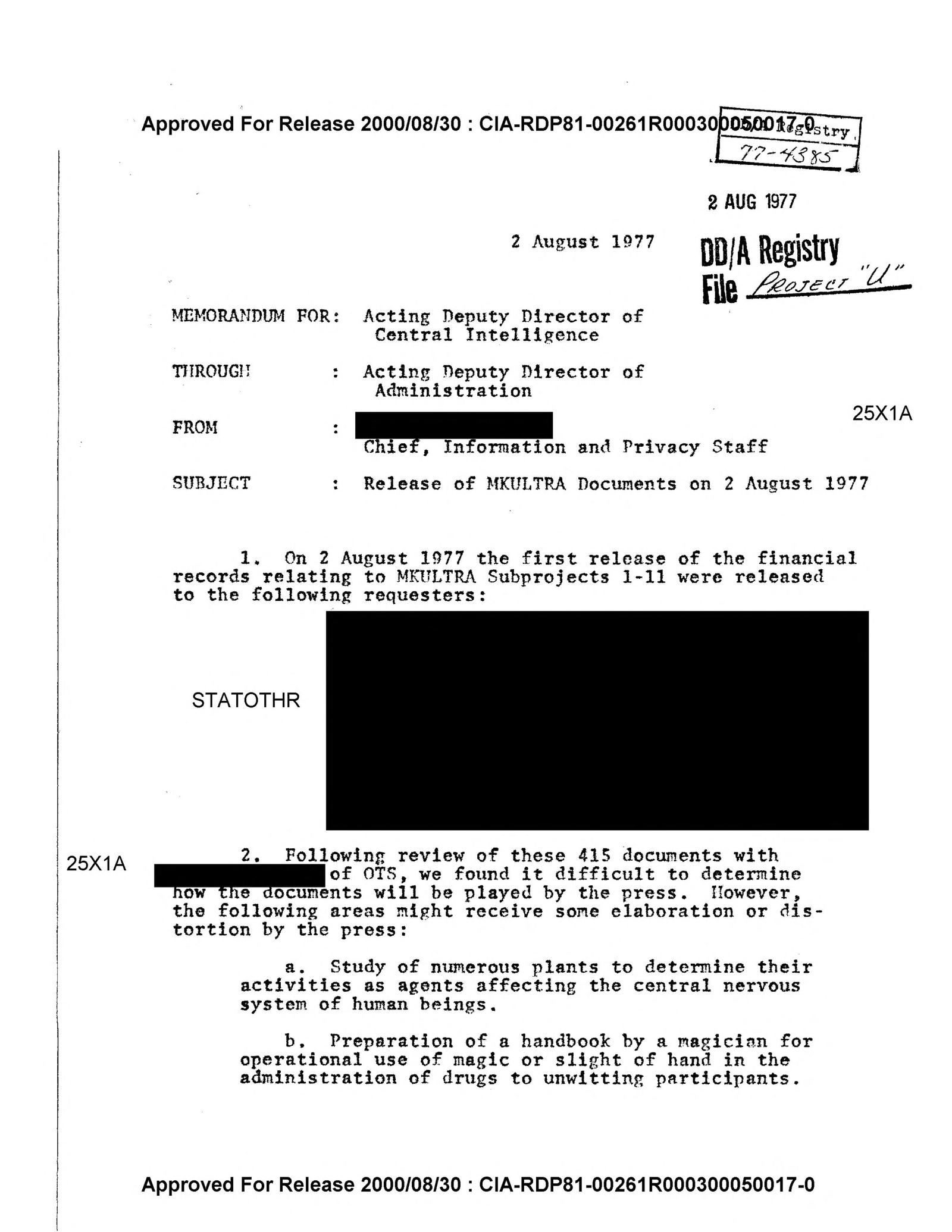
There is a more concrete answer available now, and it is a single line. Verified The one number the 1963 Inspector General put on MKULTRA — its annual budget in dollars — is still withheld, blacked out under a (b)(3) statutory exemption on p.4 of the hosted report, in a document released in 2019 about a programme that ended in 1973. The percentage survives (2.0 per cent of the Technical Services Division’s research and development budget); the figure it is a percentage of does not. Alongside it, the 1977 CREST memorandum reproduced above still redacts the list of who received the first release and the name of a Research Director — while leaving “(Chief of TSS at that time)” standing beside the black bar. Those are the specific, checkable survivals of classification on this programme: not a vault of hidden experiments, but a dollar figure and a name [2].
Primary material.
Two of the documents this file rests on are hosted here in full, with page-level guides. The rest is described below with enough specificity to be found.
The 1963 Inspector General's report on MKULTRA
48 pages, dated 26 July 1963, released by the CIA on 3 April 2019 under release identifier C06767515. Verified The only systematic internal review written while the programme was running, and the source of this file's central argument: at its paragraph 17 it records that “present practice is to maintain no records of the planning and approval of test programs.” It also recommends terminating the covert testing on unwitting Americans — in 1963, a decade before the programme ended — and it is where the annual budget figure is still redacted. Read the page-by-page guide, or open the PDF. [2]
The 3 August 1977 Senate joint hearing
173 pages, 95th Congress, 1st Session, before the Select Committee on Intelligence and the Subcommittee on Health and Scientific Research. Verified The day the agency, having said the records were destroyed, produced the ones that were not. It carries Turner's prepared statement and the seven-boxes disclosure (p.8), the fifteen-category breakdown of the 149 subprojects (p.10), the researcher and institution counts (p.11), and the official definition of MKSEARCH in its Material for the Record (p.171). Read the page-by-page guide, or open the PDF. [4]
The two documents are worth reading against each other, and Senator Kennedy's most-quoted line from the 1977 hearing is the reason why: his phrase about testing on citizens “at all social levels, high and low, native Americans and foreign” is lifted almost exactly from the 1963 report, which describes the effectiveness of the substances “on individuals at all social levels, high and low, native American and foreign.” (IG report p.14.) Verified The sentence the Senate found damning in 1977 was written by the agency about itself fourteen years earlier.
The Marks financial records
The roughly 20,000 pages recovered by John Marks under FOIA in 1977 — the misfiled Budget and Fiscal Section holdings that escaped the 1973 destruction. Verified Held at the National Security Archive, George Washington University, as the Marks Collection; the copy of the IG report hosted here comes from that collection's box 8. These are administrative and financial papers, not experimental records, which is the whole shape of the problem [12].
Documents named but not held here
The Dulles authorisation memorandum of 13 April 1953 [1]; the 1973 termination and destruction memoranda; the George Hunter White diaries, in private hands with selected pages reproduced in published work [5]; the medical files released to the Olson family in settlement [7]; and Sidney Gottlieb's closed-session testimony to Church Committee staff of 15–18 October 1975, released only in 2025 and published by the National Security Archive [14]. The CIA's FOIA reading room holds the agency's own indexed MKULTRA releases, including the 1977 CREST memorandum reproduced above; the Church Committee's final report and the 1977 hearing transcripts are at the National Archives [3][10].
The sequence.
- April 1950 Project BLUEBIRD authorized as MKULTRA's direct predecessor; renamed ARTICHOKE in 1951.
- April 13, 1953 Allen Dulles signs the memo formally authorizing Project MKULTRA. Sidney Gottlieb is named director.
- November 19, 1953 Frank Olson and several Army biological warfare colleagues are dosed with LSD without consent at Deep Creek Lake, Maryland.
- November 28, 1953 Olson falls to his death from the tenth floor of the Hotel Statler, New York. Cause of death officially recorded as suicide.
- 1954 Operation Midnight Climax begins, operating CIA safe houses in San Francisco and New York for unwitting LSD dosing of civilians.
- 1957—1964 Dr. Ewen Cameron conducts MKULTRA-funded "depatterning" experiments at McGill University's Allan Memorial Institute, Montreal.
- 1963 CIA Inspector General John Earman conducts an internal review, characterizing MKULTRA's results as of "limited usefulness."
- 1964 The date usually given for MKULTRA being “renamed” MKSEARCH. The agency’s own statement to Congress does not support it: the hearing’s Material for the Record dates MKSEARCH funding to FY1966–FY1972. See The connection to other named programs above.
- January 1973 CIA Director Richard Helms telephones Gottlieb and orders the destruction of all files on drug research and associated activities. The records are destroyed at the end of the month; the Chief of the Records Center registers a protest on February 2, by which time it is done.
- FY1972 MKSEARCH funding ends, per the 1977 hearing’s Material for the Record [4] — a year before the June 1973 termination date usually cited.
- June 1973 Project MKSEARCH terminated, on the usual dating. A further safe drawer of Gottlieb's own papers is destroyed by his secretary, on his order, shortly before he retires.
- December 22, 1974 Seymour Hersh publishes "Huge C.I.A. Operation Reported in U.S. Against Antiwar Forces, Other Dissidents in Nixon Years" in The New York Times. Public attention to CIA domestic activities begins.
- 1975 The Rockefeller Commission and Church Committee both investigate; MKULTRA is publicly named for the first time.
- February 18, 1976 President Gerald Ford issues Executive Order 11905 on U.S. intelligence activities, restricting the kinds of experimentation MKULTRA had conducted.
- July 1977 John Marks, using FOIA, recovers ~20,000 pages of MKULTRA financial records that had been misfiled and survived destruction.
- August 3, 1977 Senator Edward Kennedy's Subcommittee on Health and Scientific Research holds public hearings on MKULTRA. CIA Director Stansfield Turner testifies.
- 1979 John Marks publishes The Search for the "Manchurian Candidate", the first comprehensive public account.
- 1988 Cameron's surviving Canadian subjects win a $750,000 settlement from the CIA.
- 1994 Frank Olson's body is exhumed at the family's request. Forensic pathologist James Starrs concludes the injuries are consistent with homicide.
- 1996 Manhattan District Attorney Robert Morgenthau opens a homicide investigation into Olson's death.
- 2007 The CIA releases the "Family Jewels" documents, including additional materials on MKULTRA-adjacent programs.
- 2012 Olson homicide investigation closed without indictment.
- October 30, 2025 The National Security Archive publishes Sidney Gottlieb's October 1975 closed-session testimony to Church Committee staff, released on a 2017 FOIA request after fifty years out of public view.
- June 30, 2026 The House Oversight Task Force on the Declassification of Federal Secrets holds the hearing Mind Control and Accountability, and calls for full declassification of the remaining records.
Full bibliography.
- Memorandum from Director of Central Intelligence Allen W. Dulles, "Project MKULTRA," April 13, 1953. CIA FOIA Reading Room.
- Hosted on this site. CIA Office of Inspector General, “Report of Inspection of MKULTRA,” John S. Earman, Inspector General, 26 July 1963. 48pp. Released 3 April 2019 under CIA release identifier
C06767515; catalogued by the National Security Archive as “Report of Inspection of MKULTRA/TSD.” - Senate Select Committee to Study Governmental Operations with Respect to Intelligence Activities (Church Committee), Final Report, Book I: Foreign and Military Intelligence, 1976. Pages 385–422 cover MKULTRA.
- Hosted on this site. U.S. Senate, Joint Hearing before the Select Committee on Intelligence and the Subcommittee on Health and Scientific Research, 95th Congress, 1st Session, "Project MKULTRA, The CIA's Program of Research in Behavioral Modification," August 3, 1977. Hosted in full on this site →
- George Hunter White diaries, selected entries reproduced in Marks (1979) and Lee & Shlain (1985).
- Albarelli, H.P., A Terrible Mistake: The Murder of Frank Olson and the CIA's Secret Cold War Experiments, TrineDay, 2009.
- Ford Library Museum, statement by President Gerald R. Ford to the Olson family, July 21, 1975.
- Starrs, James E., "The Death of Frank Olson: Cause of Death," forensic report, 1994. Held in records of the Manhattan District Attorney's Office.
- Hersh, Seymour M., "Huge C.I.A. Operation Reported in U.S. Against Antiwar Forces, Other Dissidents in Nixon Years," The New York Times, December 22, 1974.
- Church Committee Final Report, Books I and III. Available in full at the National Archives (NARA) and the National Security Archive at GWU.
- Collins, Anne, In the Sleep Room: The Story of the CIA Brainwashing Experiments in Canada, Lester & Orpen Dennys, 1988.
- Marks, John, The Search for the "Manchurian Candidate": The CIA and Mind Control, Times Books, 1979. The first comprehensive public account based on the recovered FOIA documents.
- National Security Archive, "The CIA's Family Jewels," released June 2007. Briefing Book No. 222, edited by Thomas Blanton.
- National Security Archive, “The Top Secret Testimony of CIA's MKULTRA Chief, 50 Years Later,” Briefing Book No. 907, edited by Michael Evans, October 30, 2025. Sidney Gottlieb's testimony to Church Committee staff, October 15–18, 1975: declassified in 1995 during litigation but kept restricted, and released to the public in 2025 in response to a 2017 FOIA request.
- U.S. House Committee on Oversight and Government Reform, Task Force on the Declassification of Federal Secrets. Hearing, Mind Control and Accountability: Uncovering the Truth of the CIA's MKULTRA Experiments, June 30, 2026. Chair: Rep. Anna Paulina Luna. Witnesses: Stephen Kinzer, Tom O'Neill.
- Kinzer, Stephen. Poisoner in Chief: Sidney Gottlieb and the CIA Search for Mind Control. Henry Holt, 2019.
- CIA v. Sims, 471 U.S. 159 (1985). The Supreme Court's factual recital of MKULTRA — 149 subprojects, at least 80 institutions and 185 private researchers, “between 1953 and 1966” — given in the course of holding that the Agency could withhold researchers' names under the intelligence-sources exemption.
Frequently asked questions.
What is MK-Ultra?
MK-Ultra (properly Project MKULTRA) was a U.S. Central Intelligence Agency programme, authorised by CIA Director Allen Dulles on 13 April 1953, that ran 149 subprojects testing drugs, hypnosis, sensory deprivation and other methods of behaviour modification on human beings — some volunteers, some prisoners, and some people who had no idea they were being tested. It was run by the chemist Sidney Gottlieb out of the agency's Technical Services Staff. Most of its records were destroyed on Richard Helms's order in January 1973; what is publicly known comes almost entirely from about 20,000 pages of financial paperwork that were misfiled and so survived.
When did MK-Ultra end?
There is no single answer, and the CIA gave Congress two. Turner's 1977 prepared statement calls MKULTRA "a closely held CIA project conducted from 1953-1964." The same volume's Material for the Record says the successor programme, MKSEARCH, was funded from FY1966 to FY1972. The date everyone uses, 1973, is the year Helms ordered the records destroyed and Gottlieb retired — a date about the paperwork, not about the work.
Was MKSEARCH the successor to MK-Ultra?
Yes, and the official wording is worth having exactly. The 1977 joint hearing printed this: "MKSEARCH was the name given to the continuation of the MKULTRA program. Funding commenced in FY 1966, and ended in FY 1972. Its purpose was to develop, test, and evaluate capabilities in the covert use of biological, chemical, and radioactive material systems and techniques for producing predictable human behavioral and/or physiological changes." It is on page 171 of the transcript, which is hosted in full on this site.
Who was Sidney Gottlieb?
The CIA chemist who directed MKULTRA for most of its life, under the Technical Services Staff. He arranged the dosing that preceded Frank Olson's death, and in January 1973 he carried out Helms's telephoned order to destroy the programme's files. His closed-session testimony to Church Committee staff, given in October 1975, was released to the public only in 2025; in it he says the programme was "probably not a high pay-off program."
What was Operation Midnight Climax?
An MKULTRA subproject that ran from 1954 to 1965 out of CIA safe houses in San Francisco, Marin County and New York. Prostitutes were paid to bring clients to the houses, where the clients were dosed with LSD without their knowledge and watched through one-way mirrors. It is the clearest documented instance of the programme testing on people who had no idea they were subjects.
Who was George Hunter White?
The former federal narcotics officer who ran Midnight Climax under CIA contract. His private diaries, obtained after his death, contain the programme's most-quoted self-assessment: "Where else could a red-blooded American boy lie, kill, cheat, steal, rape, and pillage with the sanction and blessing of the All-Highest?"
How many people were experimented on in MK-Ultra?
Nobody knows, and the reason is structural. The CIA could tell Congress there were 149 subprojects, 185 named outside researchers and 80 institutions — 44 universities, 15 companies or foundations, 12 hospitals and 3 prisons — because each of those generated an invoice. It could not give a number of subjects, because subjects were not billed. What survived destruction was the financial file, and a financial file can only answer financial questions.
Are the MK-Ultra documents still classified?
The CIA's position is that no MKULTRA records remain classified. Historians note that adjacent files, particularly on MKNAOMI, are still partly redacted or were never indexed for release. But the deeper limit is not classification: the agency's own 1963 Inspector General report recorded that "present practice is to maintain no records of the planning and approval of test programs." Declassification can release documents that exist. Much of what is wanted was never written down.